

Quick Answer:
-
AI tools have dropped in price and complexity enough to make sense for businesses generating $ 1M-$10M in revenue.
-
Start with one annoying repetitive task (5-10 hours/week) where mistakes won’t cost you customers.
-
Expect month 1 to feel like training a dim intern, month 3 before you trust it, break-even around month 3-4
-
Keep humans in high-stakes situations (emotional, financial, complex). AI handles 80%, humans handle the crucial 20%
-
Real first-year costs: subscription is only 20-40% of total when you add setup, training, mistakes
TL;DR: AI adoption in small businesses has hit 58% because the cost finally makes sense and the tools solve real problems. Businesses that succeed with AI use it to handle repetitive grunt work, while keeping humans for relationships and judgment calls. The ones failing try to replace staff, skip fixing their processes first, or automate everything without thinking. Here’s what works, what you’ll really pay, and where AI still falls flat.
Why are small businesses actually adopting AI now?
I’ve been programming since 1981 and using AI tools since the 2000s. Back then, you needed technical chops to get them running. Now the interfaces are straightforward, and the price has hit the sweet spot for businesses turning over a million or two.
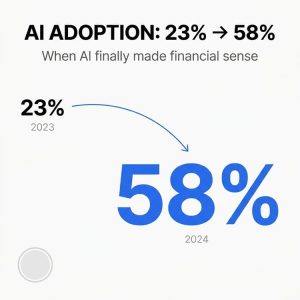
The numbers back this up. 58% of small businesses now use generative AI. That’s up from 40% in 2024 and more than double the adoption rate in 2023.
Here’s what’s different: the tools have become sufficiently specific to solve real business problems. Not party tricks. In the early days, AI did clever things that didn’t solve real problems. Now I’m seeing tools that handle customer enquiries, process quotes, and follow up on leads. The boring, repetitive stuff is eating up hours every day.
They’re accurate enough that you’re not spending more time fixing mistakes than doing it yourself.
The other shift: small business owners are finally ready. They’ve been through enough tech disappointments to be sceptical, which is healthy. They’re asking, “Will this save me time?” instead of “Is this cool?” Because the technology has matured, I give them straight answers with real numbers attached.
Key point: AI is finally specific, affordable, and accurate enough to solve real small-business problems without requiring a technical degree to run it.
How do you tell useful AI from expensive gimmicks?
Here’s my test: if you can’t write down every single rule and exception for how to do a task, AI will struggle. If getting it wrong would lose you money or customers, keep humans in the loop.
I look for three red flags telling me a task shouldn’t be fully automated:
High emotional stakes. Anything where someone’s upset or the relationship is on the line needs human oversight. I had a client automate complaint responses. Disaster. The AI was polite but couldn’t read between the lines when someone was about to churn. A human tells when “I’m following up on my complaint” means “I’m giving you one last chance before I go to your competitor.”
High financial value. For some businesses, that’s $2,000; for others, $20,000. If getting it wrong would hurt financially, don’t let AI do it unsupervised.
High complexity. Tasks needing judgment calls, context from multiple sources, or understanding unwritten rules. AI schedules meetings brilliantly until you’ve got a client who always runs late, a supplier who refuses Mondays, and a staff member needing early Thursdays for school pickup. A human juggles all that. AI sees available calendar slots.
Key point: Automate low-stakes repetitive tasks with clear rules. Keep humans in anything emotional, expensive, or complex.
What business tasks does AI actually help with?
Admin and quote processing
I had a building supplies client drowning in quote requests. About 50 a day through their website and email. Their office manager spent 15 hours weekly on initial quote responses, another 10 hours following up.
We set up an AI system handling initial quote generation for standard products. Pulling from price lists, calculating quantities and adding the standard margin.
The first month was rough. The AI got about 70% right, so we checked everything. But here’s the thing: even at 70%, reviewing and correcting was faster than creating from scratch. By month three, once we’d trained it on their specific products and pricing, it hit 95% accuracy.
Now the office manager spends 5 hours weekly reviewing AI-generated quotes and handling complex custom quotes that require a human touch.
Bottom line: Went from 25 hours weekly to 5 hours. That’s 20 hours saved per week.
Customer communication and follow-ups
The follow-ups worked even better for that building supplies client. The AI sends a reminder three days after the quote if there’s no response, then another one a week later with an “is there anything we can clarify?” message.
That recovered about $40,000 in sales in the first quarter from quotes that would’ve gone cold. Before, they didn’t have time to chase every quote.
Here’s where businesses get it wrong: they automate the entire customer conversation. 80% of consumers say they get better outcomes interacting with a human agent. Only 2% want to interact exclusively with AI chatbots.
The most common AI customer support problem: no clear, fast path to a human when the bot can’t help. And 56% of unhappy customers never complain. They leave.
Bottom line: Use AI for follow-ups and reminders. Keep humans for actual conversations.
Marketing and content creation
AI is good at generating first drafts and handling the grunt work of content creation. I use it for initial competitor analysis, blog structures, and social media variations.
But it can’t provide local context or understand your specific market. When I’m working with a client in Ashburton about their plumbing business, AI gives me generic plumbing content. It can’t tell me about the specific challenges facing Mid Canterbury’s water systems or the local building boom driving demand.
That’s where human know-how matters.
Bottom line: AI drafts, humans add the local knowledge and specific expertise.
Quoting and estimates
For my building supplies client, we set a $2,000 rule. Anything above that gets human eyes before going out. This protects against the mistakes that still happen.
Last month, the AI quoted the wrong timber grade because the customer’s description was ambiguous. Cost them about $300 to fix. When you’re processing 50 quotes daily, a $300 mistake monthly is acceptable. A $5,000 mistake on a major project wouldn’t be.
Bottom line: Set a financial threshold. Below it, AI handles it. Above it, humans check first.
Follow-up systems
This is where AI shines because it’s consistent and doesn’t forget. Humans get busy, distracted, or tired of chasing the same lead for the third time.
AI doesn’t care. It’ll send that third follow-up with the same energy as the first one.
But you need exception lists and manual overrides. I learned this the hard way with a client who automated invoice follow-ups without documenting special cases.
Bottom line: AI is brilliant at consistent follow-up, but you need manual overrides for special client arrangements.
What mistakes are businesses making with AI?
Trying to replace staff
I’ve seen this attempted three times and backfired spectacularly every time. One client, a retail business, thought they’d replace their customer service person with an AI chatbot. Saved about $45,000 yearly in salary.
Within two months, their Google reviews tanked; they’d lost two long-term corporate clients, furious about bot responses to complex issues, and the remaining staff were burnt out dealing with angry customers the bot had mishandled.
They hired someone back at a higher rate because they were desperate, then spent months rebuilding relationships. Financial cost was probably $60,000 when you factor everything in. Reputation damage was worse.
Bottom line: AI changes what people do. It doesn’t replace them in small businesses.
Automating chaos
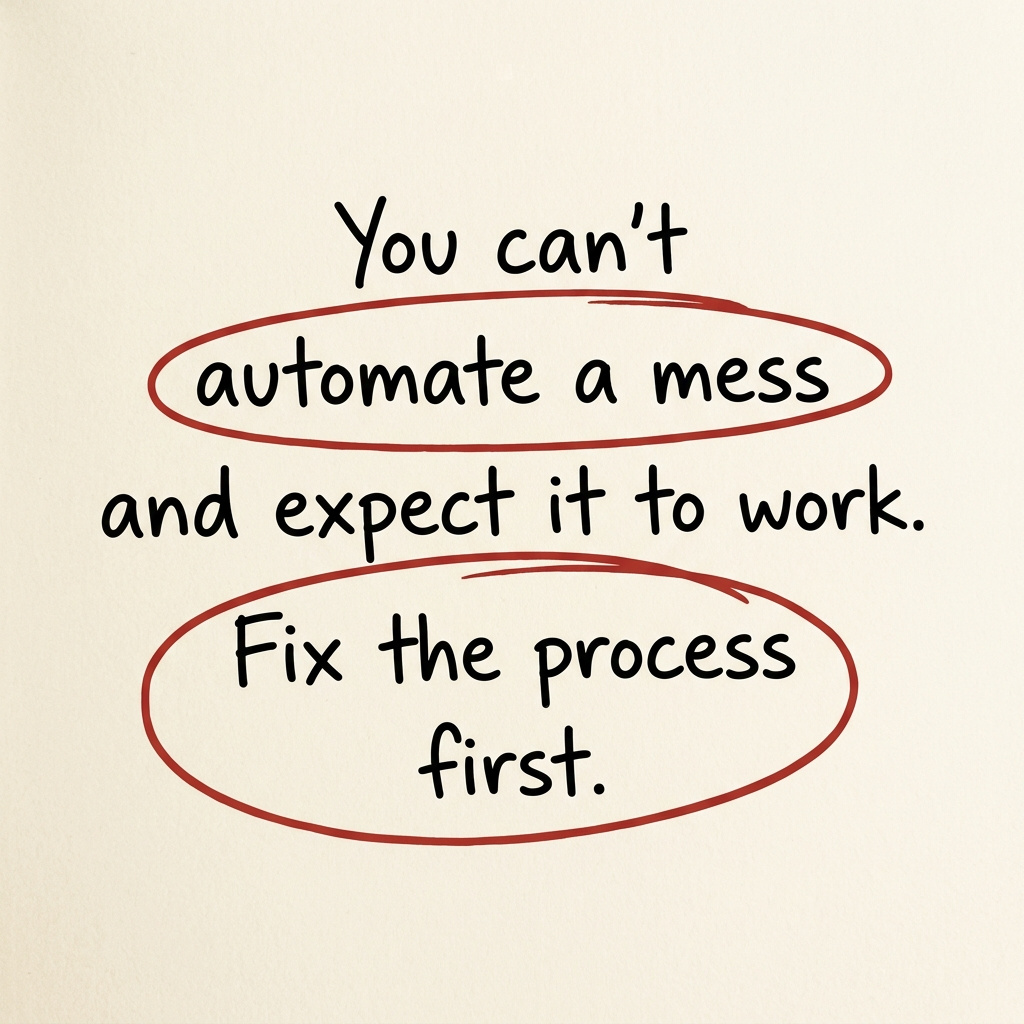
You can’t automate a mess and expect it to work. I had a marketing services client wanting to automate project onboarding. We sat down to document the process and discovered seven different workflows depending on which staff member sold the project.
We stopped the automation project right there. Spent a month standardising their process first. Standardising alone, before any AI, improved their client satisfaction scores.
Bottom line: Fix your process first. Automate later.
Ignoring setup time
Most people forget this in their sums. For that building-supplies client, I spent about 20 hours training the system, and their office manager spent another 15 hours working with me. That’s the real cost needing recovery.
Research confirms this: software costs represent only 20-35% of total AI implementation expenses. The subscription fee is only 20-40% of true first-year costs when you factor in implementation, training, and maintenance.
Bottom line: Budget for 20-40 hours of setup time, not the monthly subscription fee.
No human oversight
The worst mistake I’ve witnessed was a professional services client who automated invoice follow-ups. Their biggest client, worth about $180,000 annually, had an informal arrangement in which they always paid at 45 days due to internal approval processes.
Everyone knew this—five-year arrangement. But nobody wrote it down anywhere.
The AI sent increasingly firm payment reminders. The third had stern language about “final notice” and “reviewing our business relationship.” The client was furious. Took three meetings and a personal apology to smooth over, and they still lost about $40,000 of work that year because the relationship was damaged.
Bottom line: Document all exceptions and special arrangements before automating relationship-based processes.
What should small businesses automate first?
Start by identifying one specific, repetitive task that’s annoying someone in your business. Not the most important task, not the most complex one. The most annoying one. Something that takes 5-10 hours weekly and makes someone think “I hate doing this” every time.
Then ask yourself three questions:
Can I write down every step and exception for how we do this? If you can’t articulate it clearly enough to programme it in, AI will get it wrong eventually.
If it goes wrong, will it cost us money or customers? If yes, you need human oversight built in from day one.
Does this task need human judgment, or is it repetitive grunt work? If it needs judgment, keep humans in the loop.
My rule: if you can’t save at least 10 hours of someone’s time per week within three months, and the tool costs more than 20% of the value of those saved hours, it’s probably not worth it. The ROI needs to be obvious, not something you squint at spreadsheets to justify.
Key point: Start small with one annoying repetitive task. Test, measure results, then scale if it works.
What still needs humans?
AI doesn’t replace people in small businesses. It changes what people do.
Businesses that succeed use it to handle grunt work so staff can focus on relationships, problem-solving, and judgment calls. That building supplies client didn’t sack their office manager. She now spends time on $50,000 custom projects that require proper consultation, not on $800 standard quotes.
Relationship building
AI can’t read a room, pick up on subtle cues, or build genuine trust. When someone’s upset, worried, or making a major decision, they want to talk to a real person who understands their specific situation.
Complex judgment calls
Situations needing context from multiple sources, understanding unwritten rules, or weighing competing priorities. AI gives you information but can’t make nuanced decisions balancing business needs, customer relationships, and practical constraints.
Local and contextual knowledge
AI can tell you about international painting trends, but can’t tell you about the specific challenges of running a painting business in South Canterbury. It doesn’t know about local suppliers, seasonal weather patterns, or the building boom driving demand in your area.
The crucial 20%
In most businesses, AI handles 80% of situations brilliantly and completely falls apart on the other 20%. In a small business, that 20% is often where your profit margin lives or where customer loyalty is built.
Key point: Use AI to free up your people for the work needing human judgment, relationships, and local knowledge.
What will this actually cost you?
Let me give you the numbers nobody mentions in sales pitches.
For that building-supplies client, the AI tool cost $200 per month. Sounds reasonable. Here’s what the first three months cost:
-
Tool subscription: $600
-
My time setting it up: 20 hours at my consulting rate
-
Office manager’s time learning and training: 15 hours at her full cost to the business
-
Estimated mistake costs: $500 monthly average
They were barely breaking even in month three when you factor in all those costs. By month six, they were saving money. And that $40,000 in recovered sales from automated follow-ups made it worthwhile.
The reality: returns are often negative in the first 6-12 months due to upfront costs, though businesses typically break even by month 3-4 when properly set up.
For most SMEs, a 15-25% return is typical, with major benefits often taking 2-4 years to show up. But focused small-business pilots targeting high-frequency tasks typically break even within 3-9 months.
Key point: Real first-year costs are 2.5-5x the monthly subscription. Budget accordingly and expect to break even around month 3-4.
What if you’re feeling behind?
You’re not falling behind. You’re in a better position than businesses that rushed in six months ago and are now untangling expensive mistakes.
The AI tools aren’t going anywhere. They’re only getting better and cheaper. There’s no penalty for being thoughtful.
Research shows 82% of the smallest SMBs (under 5 employees) cite the belief that AI doesn’t apply to their business as their primary reason for non-adoption. But this drops significantly as business size increases, suggesting an education problem rather than an applicability problem.
Start small, test, measure, and scale. Use cases matter in the early stages for proving value before investing in large-scale systems.
If your processes are a mess, if everything’s different every time, if you’re not sure what your workflow even is, fix that first. You’ll get more value from a solid process than from automating chaos. Sometimes documenting and standardising your process is enough. You might not need AI.
Key point: Being thoughtful beats being first. Fix your processes, then automate what makes sense.
What will we be saying in five years?
I reckon we’ll look back and realise businesses that succeeded weren’t the ones that adopted AI fastest. They were the ones who adopted it most thoughtfully.
AI will become completely unremarkable—another tool in the toolkit, like email or accounting software. Businesses still going on about “we use AI” will sound as dated as someone in 2024 bragging about having a website.
What I reckon we’ll see is a split: businesses that use AI to amplify their people (making them more efficient and getting rid of boring work) will have thrived. Their staff will be more engaged, customers will be happier, and margins will be better.
Businesses trying to use AI to replace people or cut corners will have struggled. High turnover, poor customer relationships, and they’ll be wondering why their AI-powered competitor down the road does better despite charging more.
But fundamentally, AI doesn’t change the basic truth about small businesses. Success still comes down to relationships, quality, and solving customer problems. AI makes the admin side less painful, so you focus on those things.
Common questions about AI for small businesses
What’s the best AI tool for small businesses?
There’s no single “best” tool because it depends on what you’re automating. For customer communication, consider tools that integrate with your existing CRM. For content creation, ChatGPT or similar language models work well. For quote processing, you need something connecting to your pricing database.
The best tool solves your specific problem without requiring you to change your entire workflow to accommodate it.
Is AI expensive for small businesses?
Subscription fees are usually reasonable, ranging from $50 to $500 per month, depending on the tool. The real cost is setup time, training, and the learning curve. Budget for 20-40 hours of implementation time and expect to break even around month 3-4 if you’re doing it right.
For a business turning over $500,000 annually, start with 1% to 3% of revenue allocated to all technology, then carve out 20% to 30% of that for AI experimentation. That’s $1,000- $1,500 per year for AI tools.
Can AI replace staff?
No, and trying backfires. I’ve seen it attempted three times, and it failed spectacularly every time. AI changes what people do, but it doesn’t replace them. Use it to handle boring repetitive work so your staff can focus on relationships, complex problem-solving, and judgment calls, driving your business forward.
What business tasks should be automated first?
Start with the most annoying, repetitive task that takes 5-10 hours weekly. Something where rules are clear, stakes are relatively low if it goes wrong, and it doesn’t require complex judgment calls. Quote follow-ups, initial customer enquiry responses, and basic data entry are good starting points.
Is ChatGPT enough for most businesses?
ChatGPT is good for content drafting, research, and brainstorming. But it’s not a complete business solution. You’ll likely need it plus one or two specialised tools for your specific industry. And you’ll definitely need human oversight to add local context, check accuracy, and handle situations where AI falls flat.
How long before I see results from AI?
Start with repetitive tasks. Look for work that makes someone groan every time they do it. That’s your starting point.
Improve response times first. Automated follow-ups and initial responses are low-risk, high-value wins that build confidence in the technology.
Focus on lead handling before marketing. Getting better at following up on leads you already have delivers faster ROI than generating more leads you can’t handle.
Keep humans in customer relationships. Use AI for admin work, but keep real people handling conversations that matter.
Use AI to support staff, not replace them. The goal is to make your team more effective, not eliminate positions. When you frame it that way, you get buy-in instead of resistance.
Businesses falling behind aren’t the ones not using AI. They’re the ones not looking at their processes at all. Knowing exactly how your business runs and where inefficiencies are puts you ahead of most small businesses, whether you automate or not.
Start there, and the automation decisions become obvious.