Facebook
 YouTube
 LinkedIn
 BNI
In short: If your business only runs while you’re there holding it together, you’ve got a very demanding job with your name on the door. The way out is three steps, done in order: write down your key processes, hand over ownership of results to your people, then automate the bits that are already stable.
-
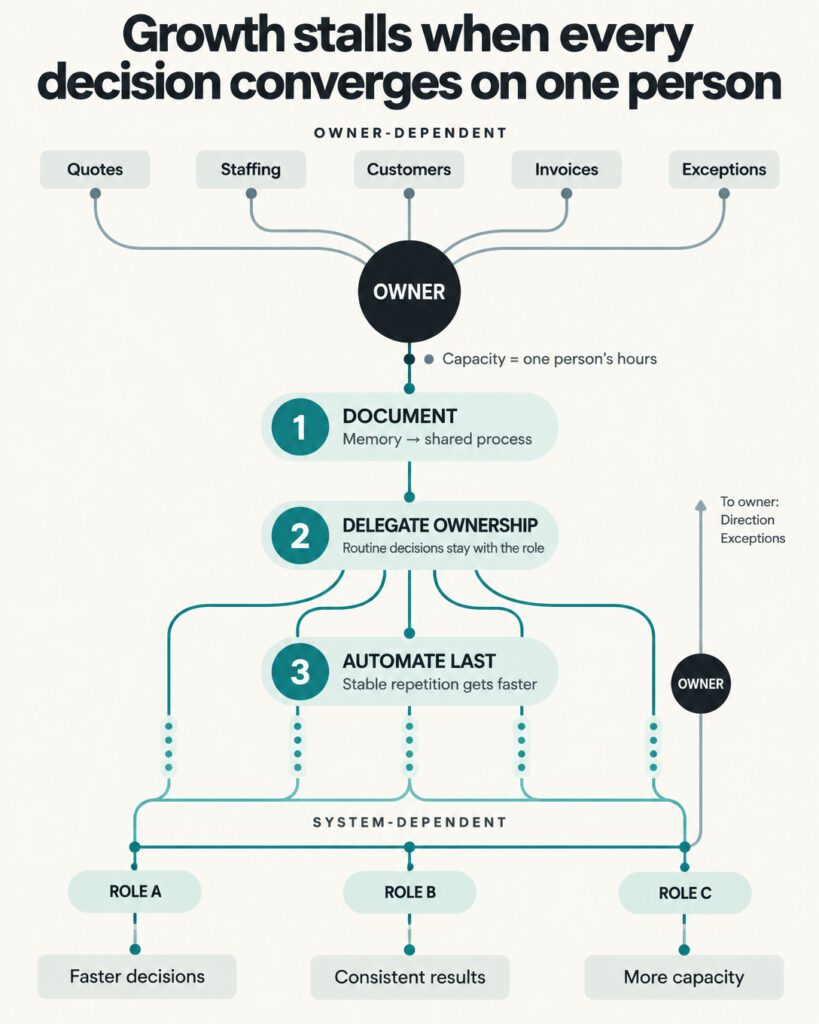
Owner-dependency means decisions, know-how and momentum all route back to the owner.
-
It stalls growth because the business can only grow as far as your hours stretch.
-
The fix is structure: document first, hand over ownership second, automate last.
-
Automating a messy process makes the mess run faster, so the order matters.
If you can’t take two weeks off without the phone ringing at the bach, this one’s for you. Over the years I’ve sat with plenty of small business owners who tell me the same thing in different words. The business is growing, the work keeps coming in, and yet every quote, every staffing question and every unhappy customer still lands on their desk.
So the business runs. But only because they’re personally holding it together. And when the owner is the thing keeping everything moving, what they really own is a very demanding job with their name on the door. You didn’t set out to build that, of course.
How does owner-dependency creep in?
It starts innocently. In the early days you do everything because there’s no one else to do it. You quote the job, do the job, chase the invoice and sort out whatever went wrong. That effort is exactly what gets a business off the ground, so it’s the right call at the time.
But the habits you form at the start tend to stick. As staff come on board, the know-how stays in your head instead of going into a written process. People learn to check with you before deciding anything, because checking with you has always been the safe option (and fair enough, it usually was). So every decision travels up to one person.
You end up as the operating manual for the whole business. Which works fine. Right up until you want it to work without you.
The short version: Owner-dependency builds up slowly from start-up habits, until all the know-how and all the decisions sit with you.
Why does owner-dependency stall growth?
Because there are only so many hours you can put in. Once they’re full, the business stops growing, no matter how much work is out there waiting.
Success can stretch an owner’s week until the hours it takes stop feeling like success at all. I’d go further, actually. More work coming into a business held together by one person is dangerous, because it just tightens the trap. Working harder makes it worse, since every extra job brings more decisions and they all route back to you.
💡 A useful test: if a result in your business depends on your memory instead of a written system, that result disappears the day you’re unavailable. Sick, on holiday, stuck on State Highway 1 with a flat phone and no idea what’s going on back at the office, whatever.
Bottom line: Your hours set the limit on growth, so more demand without more structure just means a longer week for you.
How do you get out of owner-dependency? Three steps, in order
In my six-stage Get Your Business Sorted framework, the order of the stages matters as much as the stages themselves. Getting out of owner-dependency follows a sequence, and skipping a step tends to undo the lot. I’m a bit fussy about this.
Here’s how it works in practice:
-
Document first. Start with the handful of jobs that matter most and get them out of your head and into written processes anyone can follow. You don’t need to write up everything at once. A few critical ones make a difference straight away.
-
Hand over ownership of the result. If you hand someone a task, you’re still carrying the outcome. Hand them ownership and they’re responsible for the result. They make the routine decisions and only come to you for the genuinely unusual ones, so each problem gets solved at the level where it actually sits.
-
Automate what’s already stable. Automation comes last in this sequence, and there’s a good reason for that. My guiding principle here is simple: don’t automate chaos. Putting software on top of a messy, undefined process just makes the mess run faster.
Worth remembering: Write it down, hand it over, then automate. In that order, because each step needs the one before it to hold.
Where does automation actually fit?
With my background in programming and automation, I’m the last person to talk you out of technology. But owners often grab a tool as the first move, hoping it’ll bring order to a process no one has ever written down. It doesn’t.
Automation amplifies whatever’s already in your business, good or bad. A stable, written process gets faster and more consistent. A shaky one becomes a faster way to make mistakes, which somebody then has to fix up later. Usually the bookkeeper.
And even good automation needs watching. You set it up, then you keep an eye on it. A person still has to make the judgement calls, so your job shifts from doing the work to checking the system is doing it properly.
The tech bit, simply put: Automation speeds up whatever process you give it, so give it a sound one and keep a person checking the results.
What does it look like when it works?
The goal is a business where the structure carries the load so you don’t have to. Decisions get made at the right level. Results come from written systems anyone on the team can follow, and technology speeds up processes that were already sound.
You still lead the business. You set the direction, watch the numbers and improve the systems. Your constant presence just stops being the glue holding it all together.
So if you can’t leave for two weeks without things wobbling, take that seriously. It’s a structure problem, which is actually good news, because structure can be fixed. One written process and one properly handed-over result at a time.
Where that leaves you: A business that keeps running when you step away, with you leading it instead of holding it up.
Frequently asked questions
What is owner-dependency in a small business?
It’s when the business relies on the owner for decisions, know-how and momentum, so it can’t run properly without them there.
How do I know if my business is too dependent on me?
Try the two-week test. If you can’t leave for two weeks without things wobbling, or key results depend on your memory instead of a written system, it’s too dependent on you.
Why can’t I just work harder to grow?
Because your hours are the limit. Every extra job adds decisions that come back to you, so working harder tightens the trap.
What should I document first?
The handful of activities that matter most. You don’t need to document everything at once. A few critical processes make a difference straight away.
What’s the difference between delegating a task and handing over ownership?
With a task, you still carry the outcome. With ownership, the other person is responsible for the result and makes the routine decisions, coming to you only for the unusual ones.
Should I automate first to save time?
No. Automate last, once a process is written down and stable. Automating a messy process just makes the mess run faster, which is why my rule is “don’t automate chaos”.
Can I set up automation and forget about it?
No. A person still needs to make the judgement calls and check the system is doing its job properly.
The main takeaways
-
If the business only works while you’re there, you own a demanding job, and that can be changed.
-
Owner-dependency grows out of start-up habits, when know-how stays in your head and every decision comes to you.
-
Your hours cap your growth, so working harder makes the trap tighter.
-
Get out in order: document first, hand over ownership of results, automate last.
-
Don’t automate chaos. Software speeds up whatever process it’s given.
-
Automation still needs a person checking it.