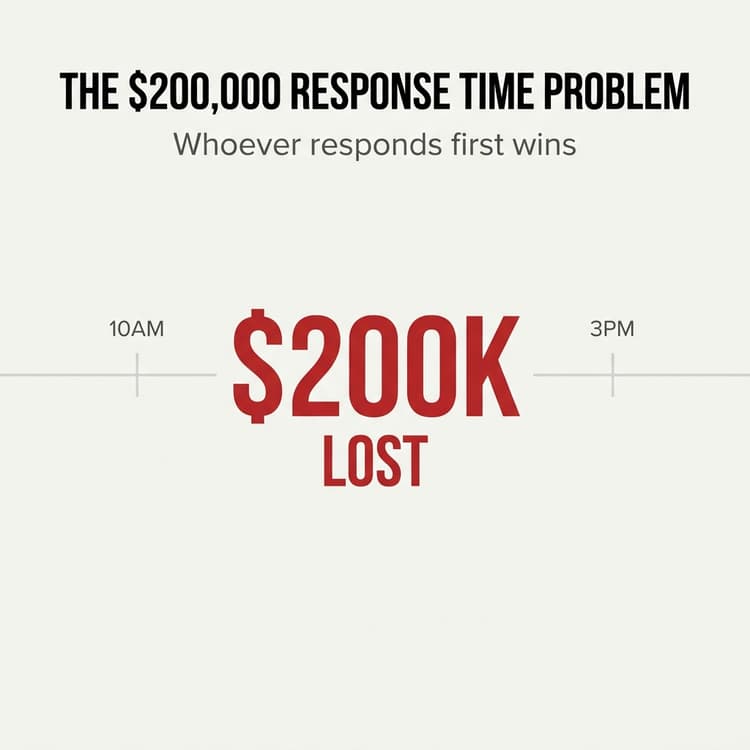


TL;DR: A plumbing company was losing 70% of its leads due to slow response times. I designed an AI-powered lead response system that increased their booking rate from 30% to 58% in two weeks, saving them $200K annually. This case study reveals why customer expectations are changing, how AI is transforming small business operations, and why operational efficiency matters more than working harder. The lesson: modern businesses need systems that work when humans are busy.
Why Small Business Operations Are Broken
Customer expectations have shifted: 78% of homeowners hire the first contractor who responds.
Speed to response determines conversion more than price or service quality
Most small businesses lose $15K-$200K yearly because of operational bottlenecks
AI-assisted workflow automation removes invisible mental load from business owners
The real transformation is operational sustainability, not revenue alone
Why Customer Expectations Are Changing
Mike’s plumbing company reflects a broader business trend. Customer behaviour has fundamentally shifted in the past five years.
Mike was getting solid enquiries. Marketing was working. The phone was ringing. But only 30% converted to jobs.
Mike blamed customer behaviour: “People aren’t serious” and “they’re price shopping.” I’ve heard this deflection dozens of times across three countries. It’s rarely true.
The problem wasn’t customer quality. The problem was operational response capability.
When I mapped their enquiry-to-booking workflow, I found systemic operational failures costing them nearly $200,000 yearly in lost revenue.
This isn’t a plumbing problem. It’s a modern business operations problem.
What Is Lead Response Automation?
Lead response automation is a business system that acknowledges, categorises, and routes customer enquiries without human intervention in the initial contact phase.
The system operates in three stages:
1. Immediate acknowledgement: Automated confirmation sent to the customer within 60 seconds of enquiry submission, setting clear expectations about next steps.
2. Intelligent categorisation: AI analysis of enquiry content to determine urgency, service type, and routing priority based on business-specific criteria.
3. Workflow routing: Automatic creation of tasks, notifications, and follow-up reminders that ensure the right person responds at the right time.
The goal isn’t to replace human communication. The goal is to eliminate the gap between when a customer reaches out and when a business can respond with meaningful attention.
In Mike’s case, that gap was five hours. In a market where 78% of customers book the first responder, five hours is business suicide.
Core principle: Lead response automation buys you time by making customers feel heard immediately, whilst giving your team the information they need to respond effectively.
The Operational Bottleneck Most Small Businesses Face
Mike’s operation looked organised on paper. They had a system. The problem was that the system required perfect conditions to work.
Here’s what their workflow looked like:
Mrs Johnson calls at 10 am about a leaking hot water cylinder. Sarah answers, writes details in a notebook, promises a callback, and hangs up.
Sarah manually enters the information into a Google Sheet. Organised. Documented. Completely invisible to Mike.
Sounds organised.
Mike is on a job site. Sarah is managing three incoming calls, a customer at the counter, and a supplier delivery.
The handwritten note sits on her desk. The spreadsheet is updated. Nobody’s monitoring it in real-time.
Mike finishes his job at 1 pm. Sarah updated the system correctly, but she didn’t notify him directly. He grabs lunch and drives to the next job. By 3 pm, he checks the spreadsheet and sees Mrs Johnson’s enquiry from five hours earlier.
He calls back. Voicemail. She’s already booked a competitor who responded in 20 minutes.
This operational failure happened multiple times daily.
They had documentation. They didn’t have operational efficiency.
Systems insight: A business system that requires perfect timing and constant human attention isn’t a system. It’s a bottleneck waiting to cost you money.
Why Most Small Businesses Struggle With Systems
Small business owners are operationally overwhelmed. They’re dealing with:
Staff pressure: Admin teams are juggling phones, walk-ins, suppliers, and paperwork simultaneously. They don’t have the spare capacity to monitor systems in real-time.
Owner availability: The person who needs the information (Mike) is physically unavailable when enquiries arrive. He’s under a sink, in a ceiling cavity, driving between jobs.
Communication gaps: Information gets documented, but doesn’t trigger action. The spreadsheet is updated, but nobody’s watching it.
Rising customer expectations: Customers expect immediate responses. They’re comparing you to Amazon, Uber, and every other business that’s trained them to expect instant acknowledgement.
Lack of operational visibility: Business owners don’t realise how slow their response times are until someone measures them. They think “pretty quick” means an hour. The market thinks “pretty quick” means five minutes.
This creates an operational environment where good intentions fail under normal business conditions.
The solution isn’t working harder. The solution is building systems that work when you’re busy.
Business reality: Small businesses don’t fail because owners aren’t trying hard enough. They fail because their operational systems collapse under real-world pressure.
The Cost of Operational Inefficiency
When I showed Mike the operational data from two weeks, he went quiet. 60% of enquiries weren’t getting a response within the first hour.
He got defensive. “We’re busy. We’re out doing work. Customers need to understand.” Fair frustration. Trade businesses are legitimately stretched thin.
The market doesn’t care.
I asked him: “How much is each lost enquiry worth to you?”
Average job value: $800. If even half of those slow-response enquiries were winnable, he was leaving $15,000 monthly on the table. Nearly $200,000 yearly.
That number reframed the conversation.
The research confirms what Mike was experiencing. Responding within the first minute boosts lead conversions by 391%. After five minutes, the odds of qualifying a lead plummet by 80%. More critically, 78% of homeowners hire the first contractor who gets back to them.
Mike’s customers weren’t price shopping. They were booking whoever had operational systems capable of responding first.
The strategic question: did he want to keep running a business that was accidentally turning away $200K in revenue because his operational systems couldn’t handle normal business conditions?
He looked at me. “So what do we do? Hire someone to monitor enquiries full-time?”
We didn’t need another person. We needed operational systems that worked when humans were busy.
Operational reality: Speed to response is the single biggest factor in lead conversion, more than price, service quality, or marketing spend.
What Makes a Small Business AI-Ready?
Before implementing AI-assisted automation, businesses need three operational foundations:
1. Measurable workflows: You need to know where enquiries come from, how they’re currently handled, and where delays occur. If you don’t measure it, you don’t improve it.
2. Clear operational roles: Who needs to know what, and when? AI can route information intelligently, but only if you’ve defined who’s responsible for what.
3. Willingness to trust systems over manual control: Business owners who need to personally touch every enquiry before acknowledging it aren’t ready for automation. AI-readiness means accepting that automated acknowledgement works better than a delayed personal response.
Mike’s business had the first two. The third took a conversation about what customers value more: a personal response five hours later, or an automated acknowledgement in 60 seconds, followed by a personal call within two hours.
Every customer chose the second option.
AI-readiness insight: Being AI-ready doesn’t mean having technical skills. It means being willing to let systems handle tasks that don’t require human judgment.
How AI Is Changing Small Business Operations
AI isn’t replacing small business owners. It’s handling the operational tasks that exhaust them.
For Mike’s business, I designed a three-layer operational system:
Layer 1: Immediate customer acknowledgement
When an enquiry arrived (phone call logged by Sarah, online form, or Google Ads submission), the system triggered an automated SMS within 60 seconds:
“Hi [Name], thanks for contacting [Company Name] about your [specific issue]. Mike will call you within the next 2 hours to discuss. In the meantime, here’s our emergency contact if it’s urgent: [number].”
This acknowledgement did three things: confirmed receipt, set clear expectations, and personalised the message by referencing their specific problem.
Layer 2: AI-powered intelligent categorisation
The system used AI to analyse enquiry content and categorise urgency. A leaking cylinder was flagged as “urgent” and triggered an immediate notification to Mike. A renovation quote request was tagged “quote” and routed to a different workflow with longer response windows.
This operational intelligence meant Mike stopped treating every enquiry the same. Urgent problems got urgent responses. Planning enquiries got thoughtful, scheduled follow-up.
Layer 3: Workflow automation and follow-up
The system created tasks in their CRM, sent Mike notifications with all relevant details, and set follow-up reminders. If Mike hadn’t marked an enquiry as contacted within 90 minutes, the system sent another nudge.
This operational layer ensured nothing fell through the cracks.
Investment: Around $200 monthly in software subscriptions. Compare that to the $15,000 in monthly revenue they were losing due to operational inefficiency.
Strategic shift: AI changed its business from reactive chaos to proactive operational control.
What Is AI-Powered Lead Qualification?
AI-powered lead qualification uses language analysis to categorise enquiries based on urgency, intent, and service requirements without human review.
Traditional lead qualification requires someone to read every enquiry and decide: Is this urgent? What service do they need? Who should handle this? That manual process creates a delay.
AI qualification happens in seconds.
For Mike’s business, I trained the AI to recognise urgency patterns in customer language:
Urgent indicators: Words like “leaking,” “burst,” “no hot water,” “blocked,” “overflowing” combined with timeframes like “now,” “today,” “emergency.”
Quote indicators: Phrases like “looking to renovate,” “planning,” “thinking about,” “quote for,” “how much for.”
Service-specific routing: Keywords that indicated whether the enquiry needed a plumber, gasfitter, or drainlayer.
The AI looked at context, not keywords alone. “No hot water for three days” is urgent. “Thinking about upgrading my hot water system next month” is not.
I tested the system on 50 historical enquiries. It achieved 90% accuracy immediately. After one week of operation and minor adjustments, it reached 95% accuracy.
The remaining 5% had a fallback: if the AI wasn’t confident (below 80% confidence threshold), it defaulted to “urgent” and flagged for manual review.
Qualification principle: AI doesn’t need perfect accuracy. It needs good-enough accuracy with clear fallbacks for edge cases.
Designing Customer Communication That Feels Human
The biggest mistake businesses make with automation is sounding robotic. “Thank you for your enquiry. Your request has been received and will be processed shortly.” Nobody talks like that.
I designed Mike’s automated messages to sound like Sarah speaking on the phone—short sentences. Friendly tone. Specific details pulled from the enquiry itself.
Instead of “We’ve received your enquiry,” it was “Thanks for getting in touch about your leaking hot water cylinder.” That one detail (naming their specific problem) made it feel like someone had read and understood their message.
I added contextual variations. If someone filled out a form at 11 pm, the message said, “Thanks for reaching out, even at this hour! Mike will call you first thing tomorrow morning.” During business hours: “Mike will call you within the next 2 hours.”
Different contexts. Different messages. All automated. All appropriate.
Here’s the critical part: I didn’t try to fake human typing. The message didn’t say “Sarah here” or pretend to be written in real-time. It acknowledged the enquiry quickly and set clear expectations.
Customers don’t mind automation if it’s helpful and honest. They mind waiting in silence, wondering if anyone saw their message.
We tested eight message variations before settling on the final versions. I read them aloud. If they sounded like corporate speak, we rewrote them. The goal sounded like a competent tradie’s office, not a call centre.
Communication design principle: Automated messages should be specific, contextual, honest about being automated, and set clear expectations.
The Modern Lead Response Workflow
Here’s how enquiries move through a modern AI-assisted workflow compared to traditional manual handling:
Traditional manual workflow:
1. Customer makes an enquiry
2. The staff member writes down the details
3. Details entered into system (if time permits)
4. Business owner checks the system when available
5. Business owner calls customer back (hours later)
6. Customer has already booked a competitor
AI-assisted workflow:
1. Customer makes an enquiry
2. AI acknowledges immediately (60 seconds)
3. AI analyses and categorises urgency
4. The system creates a task and notifies the relevant person
5. Business owner receives organised, prioritised information
6. Business owner calls a warm lead who’s already expecting contact
7. System sends follow-up reminder if no action is taken
The difference isn’t the technology. The difference is operational design.
Traditional workflows assume perfect conditions: staff availability, owner availability, and constant system monitoring. AI-assisted workflows assume real business conditions: staff are busy, owners are on job sites, and systems need to work without constant attention.
Where automation improves efficiency: Immediate acknowledgement, intelligent categorisation, task creation, follow-up reminders, and operational visibility.
Where humans still matter: Actual customer conversations, service delivery, relationship building, judgment calls, complex problem-solving.
The goal isn’t removing humans. The goal is to remove operational bottlenecks so humans can focus on high-value activities.
Workflow principle: Design systems for real business conditions, not perfect conditions.
Operational Results and Business Impact
We implemented the system on a Monday. By Wednesday, Mike called. “I don’t know if this is a coincidence, but I’ve booked seven jobs in three days. Normally, I’d be lucky to get four.”
By the end of week one, his booking rate jumped from 30% to 52%. More than half of the enquiries converted into jobs.
Here’s what convinced him the operational change was working. He got a message from a customer on Thursday afternoon: “Thanks for the quick response earlier. I called three other plumbers this morning, and you’re the only one who got back to me. When can you come out?”
The automated acknowledgement went out within a minute. Mike called back 45 minutes later. She’d already decided he was getting the job purely because his operational systems responded first.
Week two: booking rate hit 58%. We changed nothing else about his business. Same pricing. Same service quality. Same marketing spend.
The only variable was operational efficiency: response speed and automated acknowledgement.
Business transformation: 30% to 58% booking rate in two weeks, zero changes to pricing or service delivery, $200/month operational investment.
The Hidden Cost of Operational Chaos
We’d calculated the revenue impact. What we didn’t anticipate was the psychological and operational transformation.
Before implementing operational systems, Mike was constantly anxious about missing enquiries. He’d be on a job site, phone would buzz, and he’d be torn between finishing his work and checking if it was urgent. He’d lie awake at night wondering if he’d forgotten callbacks.
That constant operational stress was exhausting him.
Once the system was running, he knew every enquiry was being acknowledged and categorised. He could focus on the job in front of him without that nagging operational worry.
Three weeks in, he told me, “I’m sleeping better. I’m not lying there at 11 pm thinking ‘did I call that person back?'”
Sarah noticed the operational shift too. Mike seemed less frantic, less snappy. The system had removed an invisible mental load he’d been carrying for years.
His Google reviews improved. Customers started mentioning “quick response” and “professional communication.” That improved his search rankings. That brought in more enquiries.
It created a positive operational feedback loop we hadn’t factored into ROI calculations.
We’d built the system to stop losing revenue. It improved his reputation, operational capability, and quality of life.
That’s what good operational systems do. They don’t make you more money alone. They give you your life back.
Operational benefits beyond revenue: Better sleep, reduced stress, improved online reputation, selective client choice, and proper time off.
Sustainable Business Operations vs Operational Chaos
Mike’s daily operations transformed completely.
Before operational systems: Started every day frantically checking spreadsheets, scribbling notes, making callback lists, feeling behind before leaving the house.
After operational systems: Opens CRM, sees everything organised by priority, and knows what his day looks like.
He worked until 7 pm every night, trying to catch up. The system handles immediate acknowledgement. When he calls people back (usually within an hour or two), they’re already expecting him, and they’re warm leads.
The biggest operational shift? He’s taking Sundays off now. Properly off.
Before, he’d spend Sunday afternoon processing weekend enquiries, trying to get ahead for Monday. Now the system runs autonomously. Enquiries are acknowledged immediately and categorised appropriately. He deals with them on Monday morning when he’s fresh.
His wife mentioned this to me. “I’ve got my husband back on Sundays.”
He’s also become more selective about clients. When you’re desperate and behind, you say yes to everything. Now that his operational systems convert more enquiries, he passes on difficult customers or unprofitable jobs.
The business hasn’t grown revenue-wise alone. It’s become operationally sustainable, manageable, and enjoyable to run.
Operational sustainability markers: Organised mornings, shorter workdays, proper time off, selective client choice, reduced stress, improved work-life balance.
Why Operational Efficiency Matters More Than Ever
Small businesses are facing unprecedented operational pressure:
Rising customer expectations: Customers expect instant responses. They’re comparing you to businesses with 24/7 automated systems. If you’re still relying on manual processes, you’re competing with one hand behind your back.
Staff shortages: Hiring good admin staff is harder than ever. Even when you find someone, training them to handle complex manual workflows takes months. Automated systems work from day one.
Admin overload: The administrative burden on small businesses continues to grow—compliance, documentation, customer communication. Without operational systems, owners drown in admin work instead of doing revenue-generating activities.
Faster response expectations: The research is detailed. Responding within 5 minutes makes you 21x more likely to convert a lead. Five years ago, responding within an hour was acceptable. Today, it’s too slow.
Operational bottlenecks: Business growth creates operational complexity. More enquiries mean more admin work. Without scalable systems, growth creates chaos instead of profit.
These pressures aren’t temporary. They’re the new operational reality for small businesses.
The businesses that survive and thrive will be those that build operational systems capable of meeting modern customer expectations without requiring owners to work 80-hour weeks.
Future of small business operations: AI-assisted automation isn’t a competitive advantage anymore. It’s becoming the baseline operational requirement for sustainable business growth.
Building Systems for Client Capability, Not Technical Complexity
I nearly made the classic consultant mistake: building something technically impressive but operationally unmanageable.
My initial design had elaborate decision trees, 15 different message templates, and integration with three separate tools. Technically sophisticated. Completely unusable for Mike and Sarah.
When I showed Mike the draft, he stared at it. “Mate, I fix pipes. I don’t understand any of this.”
That was my operational reality check. I’d built something that would’ve required me to maintain it forever because they’d never troubleshoot or adjust it themselves.
So I redesigned for operational simplicity. Instead of 15 templates, we went with three (urgent, standard, quote). Instead of complex decision trees, we used simple triggers and AI categorisation with clear fallbacks. Instead of three tools, we consolidated to two platforms that they already used.
The operational principle: Simple systems that the client manages themselves will always beat sophisticated systems that require expert maintenance.
If I’d launched the complicated version, Mike would’ve called me weekly to fix things. Eventually, he would’ve turned it off and returned to the spreadsheet.
Simple and sustainable beats clever and fragile every time.
Systems design lesson: Build for the client’s operational capability, not your technical ego.
Diagnosing Your Operational Efficiency
If you’re reading this thinking “that’s me, I’m losing leads,” here’s what you need to do before implementing any automation:
Track your actual response times for one week. Not what you think they are. What they are.
Get a notebook or spreadsheet. Log every enquiry: time received, time you responded, and whether it converted to a booking.
Most business owners have no idea how slow they are. They think, “I get back to people pretty quickly.” When you measure it, “pretty quickly” is three hours, end of day, or sometimes the next morning.
You don’t fix what you don’t measure.
Do this for five business days. Calculate your average response time and conversion rate.
If your average is over an hour, you’ve got an operational problem. If it’s over two hours, you’re hemorrhaging money. If you’re converting less than 50% of enquiries, ask yourself why. Because it’s probably operational speed, not pricing or service quality.
That one week of data will tell you whether you need automation or whether you’ve got a different operational issue.
Don’t assume. Don’t guess. Measure it.
Then you’ll know what needs fixing and whether automation is the answer. I’ll bet most tradies who do this exercise will discover they’re slower than they thought, and that’s costing them more than they realised.
Operational diagnosis step: Track response times for 5 days, calculate conversion rate, and identify the operational gap.
Why Business Owners Resist Operational Change
I’ve implemented operational systems across New Zealand, Australia, and the USA. The cultural differences are fascinating. The resistance is similar everywhere.
Business owners fear automation will make them seem impersonal or cause them to lose operational control.
What still gets me is how many business owners would rather stay operationally stressed and lose money than admit they need help with something they don’t understand.
It’s a pride thing, especially with tradies and service business owners.
They’ve built their business on being competent, on fixing things. Admitting they don’t understand operational systems feels like failure.
I’ve had blokes tell me, “I’ll sort it out myself eventually,” whilst they’re turning away thousands each month. They’ll spend $500 on a tool without blinking. They won’t spend two hours with someone who understands operational systems to set it up properly.
So the tool sits unused. They say, “See, automation doesn’t work for my business.”
The other thing that surprises me is how many people think being busy is the same as being operationally successful. They wear their chaos like a badge of honour. “I’m so flat out I don’t even return calls.”
Busy and broke is still broke. Busy and stressed is still stressed.
There’s this mythology that if you’re not run off your feet, you’re not working hard enough. Rubbish. Working smart means having operational systems that let you breathe.
What gets me is when I show someone like Mike the numbers ($200K yearly walking out the door), and they still hesitate because “it seems complicated” or “I’m not a tech person.”
You don’t need to be a tech person. You need to be a business person willing to let someone who understands operational systems handle the technical bit.
That’s what I do. Some people would rather complain about being overwhelmed than fix their operational problems.
I help those who are ready to admit that their current operational approach isn’t working.
Common operational resistance: “Too complicated,” “Not a tech person,” “I’ll figure it out myself,” “Being busy means I’m successful.” All excuses that cost you money.
Strategic Lessons From Implementing AI Systems Across Three Countries
After implementing AI-assisted operational systems in New Zealand, Australia, and the USA, here are the strategic lessons:
1. Operational speed wins everywhere. It doesn’t matter what country, what industry, what service you offer. Responding within 5 minutes makes you 21 times more likely to qualify a lead compared to waiting 30 minutes. The market doesn’t care about your operational constraints. If you don’t respond fast, you lose.
2. Simple operational systems are used. Complex systems get abandoned. I’ve seen businesses spend thousands on sophisticated platforms that sit unused because they’re too complicated. The systems that work operationally are the ones the business owner understands and manages themselves.
3. Automation doesn’t replace humans. It makes operational space for them. Mike didn’t become less personal with customers. He became more operationally available to the customers who needed him. The automation handled repetitive acknowledgement tasks that nobody should be doing manually.
The operational goal isn’t removing humans from the process. The goal is to remove the invisible mental load and operational bottlenecks that exhaust business owners and cost them money they don’t realise they’re losing.
If you’re a tradie or service business owner in New Zealand reading this, and you recognise yourself in Mike’s story, the first step isn’t buying software.
The first step is measuring what’s happening in your operational systems right now.
Track your response times for one week. Calculate what those operational delays are costing you. Then we talk about whether automation is the answer.
I’m willing to bet you’ll discover the same thing Mike did. You’re not as operationally fast as you think you are. The market demands faster. Every hour of operational delay is money walking out the door.
Universal operational truth: Speed beats price, speed beats quality, speed beats everything in the initial response phase.
Frequently Asked Questions
How fast do I need to respond to leads?
Within 5 minutes for optimal conversion. Responding within the first minute boosts conversions by 391%. After 5 minutes, your odds of qualifying a lead drop by 80%. Research shows 78% of homeowners hire the first contractor who responds. In modern business operations, speed to response is more important than price or service quality in the initial contact phase.
What is workflow automation for small businesses?
Workflow automation is designing business systems that handle repetitive operational tasks without human intervention. For lead response, this means automatic acknowledgement, intelligent categorisation, task creation, and follow-up reminders. The investment typically runs $100- $ 300 per month, depending on your operational complexity. The goal is operational efficiency, not the replacement of human judgment.
Will automation make my business impersonal?
No, if designed properly. The key is operational honesty: be specific (mention their problem), contextual (adjust for time of day), and transparent (don’t fake being human). Customers don’t mind automation. They mind operational silence. A 60-second automated acknowledgement beats a 5-hour delayed personal response every time.
How accurate does AI need to be for business operations?
Around 95% accuracy is operationally sufficient. Build in fallbacks for when AI confidence is below 80%. If uncertain, default to “urgent” and flag for manual review. Perfect accuracy isn’t the operational goal. Good-enough accuracy with clear fallbacks is. The system should work in real-world business conditions, not just in perfectly theoretical conditions.
What makes a small business ready for AI systems?
Three things: measurable workflows (you know where delays occur), clear operational roles (who needs what information when), and willingness to trust systems over manual control. You don’t need technical skills. You need the willingness to work with someone who understands operational systems design. The businesses that struggle aren’t the ones lacking technical knowledge. They’re the ones refusing to admit their current operational approach isn’t working.
How do I diagnose operational inefficiency?
Track your response times for five business days. Log every enquiry: time received, time you responded, conversion outcome. Calculate your average response time and conversion rate. If your average exceeds an hour, you’ve got an operational problem. If you’re converting less than 50% of enquiries, it’s probably operational speed, not price or service quality. Measure first, then fix.
Does this work for industries beyond plumbing?
Yes. I’ve implemented AI-assisted operational systems for electricians, HVAC companies, landscapers, builders, and other service businesses across New Zealand, Australia, and the USA. Any business where customers compare multiple providers and book the first responder will benefit from operational automation. The principles of workflow design, customer communication, and operational efficiency apply across industries.
What’s the biggest operational systems mistake?
Overcomplicating the design. Business owners build elaborate workflows with 15 scenarios and three separate tools. Then they don’t understand how to manage it, so it sits unused. Simple operational systems that the client manages themselves will always beat sophisticated systems requiring expert maintenance. Build for the client’s capability, not your technical ego.
Key Takeaways: Building AI-Assisted Business Operations
Operational speed determines conversion. 78% of customers hire the first responder. If you don’t respond within an hour, you’re losing money to competitors with better operational systems.
Measure your operational efficiency first. Track response times for five days. Calculate what delays cost you. You don’t fix what you don’t measure. Most business owners discover they’re slower than they thought.
Simple operational systems beat complex ones. Three message templates, basic categorisation triggers, and clear fallbacks will outperform elaborate workflows you don’t understand. Build for sustainability, not sophistication.
Design automation that feels human. Be specific about their problem, contextual about timing, and honest about being automated. Set clear expectations. Customers value operational honesty over fake personalisation.
The real operational win isn’t just revenue. Yes, Mike went from a 30% to a 58% booking rate and saved $200K annually. The bigger win was operational sustainability: getting his Sundays back, sleeping through the night, and enjoying his business again.
AI doesn’t need operational perfection. 95% accuracy with clear fallbacks is good enough. Build systems that work in real business conditions with busy staff and unavailable owners, not in perfectly theoretical conditions.
Operational efficiency beats working harder. Being busy isn’t the same as being operationally successful. Systems that let you breathe will grow your business more sustainably than chaos ever will. AI-assisted automation is becoming the baseline operational requirement for small business sustainability.
Most small business owners are not losing leads because they are bad at what they do. They are losing leads because their systems were built for a slower world. If your business is struggling with slow follow-up, admin overload, missed enquiries or operational chaos, there is usually a better way to handle it.
AI and automation are no longer just for large companies with huge budgets. Practical systems can now help small businesses save time, improve customer communication and create more sustainable operations. If you would like help identifying where automation, smarter workflows or AI systems could improve your business, please visit the contact page and get in touch.