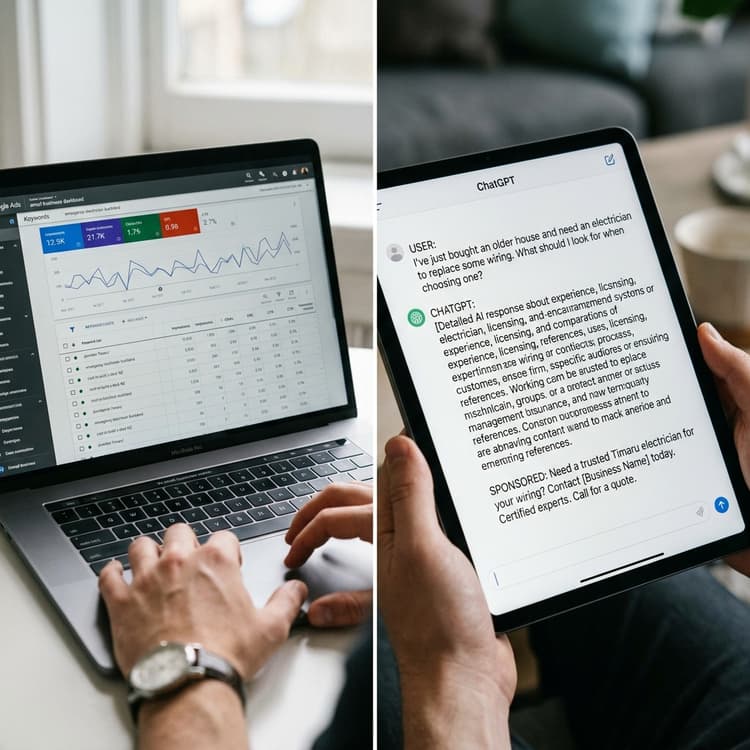


TL;DR: Google Ads captures people ready to buy now through keyword searches. ChatGPT Ads reaches people in the research phase through conversational questions. Google has a massive reach and proven ROI. ChatGPT has lower competition and costs right now. Most small businesses should start with Google Ads, then test ChatGPT Ads if budget allows. Both platforms work together, not against each other.
Google Ads dominates transactional searches. ChatGPT Ads captures conversational intent. Which one fits your business?
Quick Answer:
Google Ads works best for businesses needing local targeting, high search volume, and immediate buying intent (plumbers, electricians, retailers)
ChatGPT Ads suits professional services, consultants, and businesses comfortable with research-stage leads who provide rich conversational context.
ChatGPT Ads currently cost $3 to $5 per click vs Google’s $1 to $50+ (depending on industry)
Start with Google Ads if your budget is under $1,000/month. Test both platforms if you’re spending $1,000+ monthly.
The platforms complement each other: Google captures bottom-funnel buyers, ChatGPT captures mid-funnel researchers.
Small business owners across New Zealand, Australia, the US, Canada, and the UK keep asking me the same question: where should I spend my advertising budget?
I’ve run digital marketing campaigns since the 1990s. I’ve watched banner ads come and go, saw Google AdWords launch in 2000, navigated social media advertising, and now I’m testing AI-powered conversational ads.
This isn’t theory. I work with small business owners every week who need clear answers about where their marketing budget goes.
The arrival of ChatGPT Ads changes the conversation. You’re not choosing between good and bad. You’re choosing between two different approaches to reaching customers.
Here’s what you need to know about both platforms, what they cost, who should use them, and how to decide which one makes sense for your business.
What Are Google Ads?
Let me start with the platform most of you already know.
Google Ads is the advertising system that puts your business at the top of Google search results, on websites across the internet, in YouTube videos, and in Google Shopping results. It’s been around since 2000, which means it’s had 25 years to mature, refine, and become the dominant force in online advertising.
Here’s how it works in plain English:
You choose keywords that potential customers might search for. When someone types those keywords into Google, your ad appears. You only pay when someone clicks your ad. That’s called cost-per-click (CPC) bidding.
The system runs on an auction. Every time someone searches, Google runs a split-second auction among all advertisers bidding on that keyword. The winners get their ads shown. But it’s not just about who bids the highest. Google also considers your ad quality, your landing page experience, and how relevant your ad is to the search. That’s called Quality Score.
The scale is massive. Google processes over 8.5 billion searches every day. That’s roughly 485 million paid clicks happening daily across all advertisers.
Google Ads offers several campaign types:
Search Ads: Text ads that appear above organic search results
Display Ads: Visual banner ads on millions of websites
Shopping Ads: Product listings with images and prices
Video Ads: Ads on YouTube
Performance Max: AI-driven campaigns across all Google properties
Local Services Ads: For local service businesses like plumbers and electricians
The average cost per click varies wildly by industry. General terms might cost you $1 to $2 per click. Mid-tier competitive keywords run $5 to $10. Highly competitive industries like legal services or finance can hit $20 to $50+ per click.
The average click-through rate for Google search ads sits around 3.17%. That means if your ad gets 1,000 impressions, you can expect roughly 32 clicks.
Google Ads has proven ROI benchmarks. The often-cited figure is $2 returned for every $1 spent, though well-optimised campaigns in the right industries can hit $8 for every dollar invested.
What Are ChatGPT Ads?
Now let’s talk about the new player.
ChatGPT Ads launched in the United States on 9 February 2026. OpenAI rolled them out to Australia, New Zealand, and Canada in mid-April 2026. On 5 May 2026, they opened self-serve access through their Ads Manager at ads.openai.com.
These ads work differently from anything you’ve seen before. They appear below ChatGPT’s responses to user prompts. They’re labelled as “Sponsored”, and they only show up for users on the Free and Go subscription tiers. If you’re paying for Plus, Pro, Business, Enterprise, or Education plans, you won’t see ads.
The platform has roughly 300 million weekly active users sending about 2.5 billion prompts each day. That’s a big audience, but it’s still smaller than Google’s reach.
ChatGPT Ads don’t use keywords. Instead, they use context hints. You tell OpenAI what topics, industries, or types of conversations should trigger your ad. Their AI matches your ad to relevant conversations.
Current pricing sits at $3 to $5 per click (CPC) or $25 to $60 per thousand impressions (CPM). That CPM has dropped from the $60 launch price as more advertisers joined and competition increased. There’s no minimum spend requirement, which makes testing accessible for small businesses.
If you want a deeper breakdown of how ChatGPT Ads work for small businesses specifically, I’ve written a full guide to ChatGPT Ads that covers setup, targeting, and strategy.
How Google Ads Work
Let me walk you through the mechanics of Google Ads so you understand what you’re working with.
Keyword targeting is the foundation. You select keywords that potential customers might search for. Google offers three match types:
Broad match: Your ad shows for searches related to your keyword, including synonyms and variations
Phrase match: Your ad shows when the search includes your keyword phrase in the same order
Exact match: Your ad shows only when the search matches your keyword exactly (with some close variations)
Quality Score affects everything. Google grades your ads on a scale of 1 to 10 based on expected click-through rate, ad relevance, and landing page experience. A higher Quality Score means lower costs and better ad positions.
Ad Rank determines where your ad appears. Google calculates it by multiplying your maximum bid by your Quality Score. So you can actually outrank competitors who bid higher if your ad quality is better.
You have multiple bidding strategies to choose from:
Manual CPC: You set the maximum you’ll pay per click
Target CPA: Google optimises bids to hit your target cost per acquisition
Target ROAS: Google optimises for your target return on ad spend
Maximise conversions: Google automatically sets bids to get the most conversions within your budget
Ad extensions let you add extra information like phone numbers, location, site links, and callouts. These improve your ad’s visibility and click-through rate.
Geographic targeting lets you show ads only in specific countries, regions, cities, or even radius targeting around a physical location. Demographic targeting filters by age, gender, household income, and parental status.
Remarketing is powerful. You can show ads to people who’ve already visited your website, creating multiple touchpoints with potential customers.
Conversion tracking connects your ads to actual business results. You install a tracking code on your website that tells Google when someone completes a valuable action like filling out a form, making a purchase, or calling your business.
How ChatGPT Ads Work
ChatGPT Ads operate on a completely different model.
Instead of keywords, you provide context hints. You tell OpenAI about your business, your target audience, and the types of conversations where your ad would be relevant. Their AI then matches your ad to appropriate prompts.
The system uses what’s called a relevance-weighted second-price auction. When multiple advertisers could match a conversation, OpenAI’s AI ranks them by relevance and bid. The winner pays just enough to beat the second-place bidder, similar to how Google’s auction works.
Your ad appears below ChatGPT’s response, after the AI has finished answering the user’s question. This is different to Google, where ads appear before or alongside search results.
The matching is conversational, not keyword-based. If someone asks, “How do I choose a good accountant for my small business in New Zealand?”, ChatGPT might show an ad for an accounting firm. But the advertiser didn’t bid on the phrase “choose a good accountant”. They provided context about their accounting services for small businesses in New Zealand.
You get two buying options: CPM (cost per thousand impressions) or CPC (cost per click). Most small businesses should start with CPC because you only pay for actual clicks.
The reporting is basic compared to Google. You see impressions, clicks, spend, click-through rate, average CPC, average CPM, and conversions. But you don’t get demographic breakdowns, geographic detail, or device-level data. Everything is aggregate only.
There’s no demographic targeting, no device targeting, no time-of-day targeting, and no remarketing. You can’t exclude certain audiences or layer targeting criteria the way you can with Google Ads.
Keyword Intent vs Conversational Intent: The Core Difference in ChatGPT Ads vs Google Ads
This is the most important section of this entire article. The fundamental difference between these platforms isn’t just technical. It’s about how people express intent.
Let me show you with a real example.
Google search example: Someone types “electrician Timaru” into Google. Two words. Minimal context. You know they want an electrician in Timaru. That’s all you know.
You don’t know if they need emergency service or routine work. You don’t know if they’re comparing options or ready to book. You don’t know what problem they’re trying to solve. But you do know they’re actively looking right now.
ChatGPT conversation example: Someone asks, “I’ve bought an older house and need an electrician to replace some wiring. What should I look for when choosing one?”
Look at what that tells you:
They’ve just bought a house (major life event, likely have a budget)
They have an older property with wiring issues (specific problem)
They’re actively comparing options (research stage)
They want to make a good choice (quality matters to them)
They’re asking for guidance (open to expert recommendations)
That’s a high-quality lead signal. You know their situation, their problem, and their mindset.
Here’s the trade-off: keyword intent is transactional and efficient. Conversational intent is richer but rarer.
On Google, roughly 29% of searches result in a click on an ad or organic result. That’s high. When someone searches “emergency plumber Auckland”, they’re clicking something.
On ChatGPT, only 1% to 3% of prompts generate clicks. Most people get their answer from the AI and move on. They’re not in clicking mode. They’re in conversation mode.
This creates a quality versus quantity trade-off. Google gives you volume. ChatGPT gives you depth. Google captures people ready to act now. ChatGPT captures people still figuring things out.
Neither is better. They serve different purposes in the customer journey.
Lead Quality Comparison: ChatGPT Ads vs Google Ads
Let me break down lead quality across different business types and buying stages.
Research-Stage Enquiries
ChatGPT users are often still researching. They’re asking questions like “what’s the difference between a mortgage broker and a bank?” or “how much does it cost to build a deck in New Zealand?”
These are valuable leads if you’re willing to nurture them. They’re early in the journey, but they’re actively seeking information. If you can provide helpful content and stay top of mind, you’ll be there when they’re ready to buy.
Google users searching these types of informational queries are less common in paid search. Most informational searches go to organic results. Google Ads captures more transactional searches.
Buying-Stage Enquiries
Google dominates here. Searches like “plumber near me”, “buy running shoes online”, or “book a hotel in Auckland” show clear buying intent. These people are ready to act.
ChatGPT can capture buying-stage intent, but it’s less common. Someone might ask, “Which accounting software should I buy for my business?” and that’s a buying signal. But the volume is lower than Google’s “near me” and high-commercial-intent searches.
Local Service Businesses
Google has a massive advantage for local businesses. Local Services Ads, location targeting, and “near me” searches drive qualified local leads.
ChatGPT has no location targeting yet. You can’t target Timaru specifically or exclude Auckland. This is a significant gap for local businesses. Your ad might show up to someone asking about electricians in Sydney when you only serve Christchurch.
Professional Services
Both platforms work well for accountants, consultants, lawyers, and business advisers. Google captures the “I need an accountant now” searches. ChatGPT captures the “help me understand my tax obligations” conversations.
I’ve found ChatGPT particularly good for professional services because people ask detailed questions that reveal their situation. A lawyer might target conversations about employment disputes, business contracts, or property transactions. The context is richer than a simple keyword search.
Ecommerce Businesses
Google Shopping Ads are well-established and effective for product-based businesses. You can show product images, prices, and reviews directly in search results.
ChatGPT Ads aren’t yet suited to product browsing. People don’t ask ChatGPT to show them options for buying shoes. They ask for recommendations, then go elsewhere to purchase. The conversion path is longer and harder to track.
Cost Comparison: ChatGPT Ads vs Google Ads
Let’s talk about what you’ll actually pay.
Google Ads pricing varies dramatically by industry and competition:
General terms: $1 to $2 per click
Mid-tier competitive keywords: $5 to $10 per click
Highly competitive industries (legal, finance, insurance): $20 to $50+ per click
A small business running Google Ads typically needs at least $10 to $30 per day to get meaningful data. There’s no hard minimum, but below that, you’re not generating enough clicks to optimise effectively.
ChatGPT Ads pricing is currently lower but evolving:
Recommended starting CPC: $3 to $5 per click
CPM pricing: $25 to $60 per thousand impressions (down from $60 at launch)
No minimum spend requirement
The reason ChatGPT Ads are cheaper right now is simple: less competition. Google has 25 years of advertisers bidding against each other, driving prices up. ChatGPT launched in February 2026. The auction is less crowded.
This won’t last. As more advertisers join ChatGPT Ads, CPCs will rise. Early adopters benefit from lower costs now.
ROI is where things get interesting. Google has proven ROI benchmarks across industries. You can find case studies, average conversion rates, and expected returns for almost any business type.
ChatGPT Ads ROI is unproven and varies wildly. Some advertisers report conversion rates 1.5 to 4 times higher than Google in matching verticals. Others see poor results because their business doesn’t suit conversational advertising.
My advice: budget separately for testing. Don’t pull money from a working Google Ads campaign to test ChatGPT. Add a small test budget and measure the results independently.
Targeting Comparison: Google Ads vs ChatGPT Ads
Targeting capabilities are night and day different.
Google Ads targeting options:
Keywords with three match types (broad, phrase, exact)
Location targeting (countries, regions, cities, radius)
Demographic targeting (age, gender, household income, parental status)
Device targeting (mobile, desktop, tablet)
Time of day and day of week scheduling
Remarketing to website visitors
Customer match (upload your customer list)
Similar audiences (reach people like your customers)
In-market audiences (people actively researching products/services)
Affinity audiences (people with specific interests)
ChatGPT Ads targeting options:
Context hints (describe your ideal conversation)
Conversational topic matching
That’s it
No location targeting. No demographic targeting. No device targeting. No remarketing. No audience lists.
Google wins on targeting precision and control. You can layer multiple targeting criteria to reach exactly who you want.
ChatGPT wins on depth of intent signal. The conversational context reveals more about the person’s situation than a keyword search does.
Which matters more depends on your business. Local businesses need location targeting, so Google is essential. Professional services might value the conversational depth more.
Reporting and Analytics: What You Can Actually Measure
Reporting is where Google’s maturity really shows.
Google Ads reporting includes:
Search terms report (see exactly what people searched)
Quality Score for each keyword
Impression share (how often your ads show vs total available impressions)
Auction insights (compare your performance to competitors)
Geographic reports (performance by location)
Device reports (mobile vs desktop performance)
Time of day and day of week reports
Conversion paths (see the journey from first click to conversion)
Attribution models (understand how different touchpoints contribute)
Integration with Google Analytics 4 for deeper website behaviour analysis
You can answer questions like “which keywords drive the most conversions?”, “What time of day performs best?” “Are mobile users converting?”, and “How many touchpoints does it take before someone converts?”
ChatGPT Ads reporting includes:
Impressions
Clicks
Spend
Click-through rate (CTR)
Average CPC
Average CPM
Conversions (if you’ve set up tracking)
That’s aggregate data only. No demographic breakdown. No geographic granularity. No device-level data. You can’t see which conversations or context hints performed best.
UTM parameters and conversion tracking are supported, but the data you get back is limited compared to Google.
For small businesses used to detailed Google Ads reports, ChatGPT’s reporting feels basic. You’re flying with less instrumentation.
Advantages of Google Ads
Let me lay out why Google Ads remains the dominant platform.
Massive audience reach. Over 8.5 billion searches happen on Google every day. That’s unmatched scale. Whatever you sell, your potential customers are searching on Google.
25 years of maturity. The platform has been refined constantly since 2000. Features that didn’t exist five years ago are now standard. The tools are sophisticated and battle-tested.
Proven ROI across industries. You can find benchmarks, case studies, and expected returns for almost any business type. The uncertainty is lower.
Granular targeting. You can layer multiple targeting criteria to reach exactly who you want, when you want, where you want.
Detailed reporting. You get the data you need to optimise campaigns and prove ROI to stakeholders.
Multiple campaign types. Search, Display, Shopping, Video, Performance Max, and Local Services Ads give you options for different goals and industries.
Local targeting. For local service businesses, Google’s location targeting and Local Services Ads are powerful lead generators.
Established best practices. There’s a wealth of knowledge about what works. You can hire experienced Google Ads specialists or learn from thousands of resources.
Integration with other tools. Google Ads connects seamlessly with Google Analytics 4, Google Tag Manager, CRM systems, and marketing automation platforms.
Advantages of ChatGPT Ads
Now, let me explain why ChatGPT Ads deserve your attention.
Emerging platform with lower competition. You’re getting in early. CPCs are lower than they’ll be in two years. Early adopters build experience while costs are manageable.
Conversational context captures richer intent. A detailed question reveals more about someone’s situation, problem, and buying stage than a two-word search query.
No minimum spend to test. You can start with $100 and see what happens. Google requires $300 to $900 to gather meaningful data.
Costs are currently lower than Google’s for competitive niches. If you’re in legal, finance, insurance, or another high-CPC industry on Google, ChatGPT’s $3 to $5 CPC looks attractive.
Privacy-friendly. Advertisers only get aggregate data. You don’t see individual user information. OpenAI doesn’t share chat histories or personal details. This builds user trust.
Ads don’t influence AI answers. OpenAI is clear that ads don’t affect what ChatGPT tells users. The answer is optimised for helpfulness, not advertiser interests. This maintains trust in the platform.
300 million weekly users are growing fast. The audience is smaller than Google’s, but it’s growing. These are often educated, tech-savvy users comfortable with AI tools.
AI search is the direction the web is heading. Learning conversational advertising now positions you for the future. This skill will become more valuable, not less.
Disadvantages of Google Ads
Google Ads isn’t perfect. Here are the real problems.
Competitive and expensive in many industries. If you’re a lawyer, dentist, or plumber in a major city, your CPCs can be brutal. Small budgets get eaten quickly.
Click fraud is a real issue: competitors, bots, and accidental clicks waste budget. Google’s fraud detection helps, but it isn’t perfect.
Requires ongoing management and expertise. You can’t just set it and forget it. Campaigns need constant monitoring, testing, and optimisation. Many small businesses struggle with this.
Can burn a budget quickly without proper setup. I’ve seen businesses waste thousands on broad match keywords, poor ad copy, or irrelevant traffic because they didn’t know what they were doing.
Becoming more complex with AI-driven campaigns. Performance Max campaigns use Google’s AI to optimise across all properties. That sounds good, but you lose control. You can’t see which placements worked or pause underperforming elements.
Zero-click searches are reducing traffic. Around 58% to 60% of Google searches in the US and EU end in zero clicks. Users get answers directly from featured snippets, knowledge panels, and AI Overviews. This reduces the pool of people who click ads.
Disadvantages of ChatGPT Ads
ChatGPT Ads have significant limitations you need to understand.
Very low click-through rates. Only 1% to 3% of prompts generate clicks. Most people get their answer and move on. They’re not in clicking mode.
No keyword targeting. You can’t bid on specific search terms. You provide context hints and hope OpenAI’s AI matches you to relevant conversations. That’s less control.
No location targeting. This is a massive gap for local businesses. You can’t target Timaru or exclude overseas users. Your ad might show up to someone in another country.
Limited reporting. No demographics, no geographic detail, no device data. You’re optimising with less information.
Restricted ad placement. Ads don’t appear in temporary chats, sensitive topics, or for paying subscribers. Your reach is limited to Free and Go plan users.
Uncertain ROI. The platform is new. Best practices haven’t been established. You’re testing in the dark compared to Google’s proven benchmarks.
Best practices not yet established. There aren’t thousands of case studies or experienced ChatGPT Ads specialists to hire. You’re learning as you go.
Only reaches Free and Go plan users. Anyone paying for Plus, Pro, Business, Enterprise, or Education plans won’t see your ads. You’re missing a segment of the audience.
Which Businesses Should Use Google Ads?
Let me give you specific examples of businesses where Google Ads should be your primary platform.
Plumbers
Searches like “emergency plumber Auckland” or “blocked drain Christchurch” show immediate, strong buying intent. Someone with a flooded bathroom isn’t browsing options. They’re calling the first plumber they find. Google captures these high-urgency searches perfectly.
Builders
Searches like “builders near me”, “home renovation quotes Wellington”, or “deck builder Tauranga” indicate someone ready to get quotes. Yes, the CPC is high (often $10 to $30), but the job values are high too. One client can justify months of ad spend.
Electricians
Local Services Ads work particularly well for electricians. You pay per lead, not per click. Google verifies your licence and insurance. Your business shows up with a green checkmark and customer reviews. Searches like “electrician Timaru” or “electrical safety inspection” drive qualified local leads.
Landscapers
Seasonal Google Ads campaigns work well. Ramp up spending in spring when people search “garden design”, “lawn mowing service”, or “landscape gardener”. Scale back in winter. The seasonality matches search behaviour perfectly.
Retailers
Google Shopping Ads are powerful for product-based businesses. Someone searching “buy running shoes online NZ” sees product images, prices, and reviews directly in search results. The click-through rates are strong, and the intent is clear.
Professional Services
Accountants, lawyers, consultants, and financial advisers all benefit from Google Search Ads. Searches like “accountant for small business”, “employment lawyer Auckland”, or “business consultant Christchurch” show clear service intent.
Which Businesses Should Consider ChatGPT Ads?
Now let me show you where ChatGPT Ads can work well.
Accountants and Tax Advisers
People ask ChatGPT, “How do I set up a company in New Zealand?” “What’s the difference between a sole trader and a limited company?”, or “Can I claim my home office as a business expense?”
These questions reveal someone in the early stages of business setup or tax planning. An accountant’s ad appearing below that answer reaches them at exactly the right moment. They’re seeking guidance, not just a service provider.
Business Consultants
Questions like “what CRM should a small business use?”, “How do I improve my cash flow?” or “What’s the best way to find new customers?” show someone wrestling with business challenges.
A business consultant’s ad can position them as the expert who helps solve these exact problems. The conversational context is rich.
Software Companies
People ask ChatGPT “best project management tool for a team of 5”, “which accounting software works in New Zealand?”, or “how do I automate my email marketing?”
Software ads appearing after these questions reach people who are actively comparing options. The conversion path might be longer (they’ll want to try a demo), but the lead quality is high.
Builders and Tradespeople
Questions like “Do I need council consent for a deck in New Zealand?”, “How much does it cost to renovate a bathroom?” or “What’s involved in building a tiny house?” shows someone in the research phase.
A builder’s ad can position them as the expert who not only knows the regulations but can handle the project. You’re capturing leads before they start searching for quotes on Google.
Educators and Coaches
People ask ChatGPT, “How do I improve my public speaking?” “What’s the best way to learn digital marketing?”, or “How can I become more confident at work?”
A coaching service or online course appears after that answer reaches someone actively seeking self-improvement. The intent signal is clear.
Can Businesses Use Both ChatGPT Ads and Google Ads?
Yes. And most businesses eventually will.
These platforms serve different stages of the customer journey. They’re complementary, not competitive.
Google Ads captures high-intent search traffic now. Someone searching “plumber near me” or “buy laptop online” is ready to act. You want to be there.
ChatGPT Ads captures conversational and research-stage intent. Someone asking “what should I look for in a good plumber?” or “which laptop is best for video editing?” is earlier in the journey. But they’re actively seeking information and open to recommendations.
Think about it like this: Google is the bottom of the funnel. ChatGPT is in the middle of the funnel. You need both to cover the full customer journey.
Here’s a practical approach: run Google Ads as your primary channel with proven ROI. Add ChatGPT Ads as a separate test budget. Measure cost per lead on both platforms. Track which leads convert to customers. Adjust your allocation based on results after 60 to 90 days.
Don’t pull money from a working Google Ads campaign to test ChatGPT. Add a new budget if you can. If you can’t, start with a very small ChatGPT test (maybe $200 to $500) and see what happens before making bigger changes.
A Suggested Strategy for Small Businesses: How to Allocate Your Budget Between ChatGPT Ads vs Google Ads
Let me give you a practical budget framework based on what I’ve seen work.
Under $1,000 per Month
Focus on Google Ads only.
Your budget is too limited to test both platforms effectively. Spreading $1,000 across two platforms means $500 each, which isn’t enough to gather meaningful data on either.
Start with Google Search Ads on your highest-intent keywords. If you’re eligible, add Local Services Ads. Don’t spread your budget thin across Display, Shopping, and Video. Focus on what drives immediate results.
Skip ChatGPT Ads for now. Build your Google Ads foundation first.
$1,000 to $5,000 per Month
Allocate 70% to 80% to Google Ads, 20% to 30% to ChatGPT Ads as a test.
At this budget level, you can afford to test. Put $700 to $900 into Google Ads (your proven channel) and $200 to $300 into ChatGPT Ads (your test).
Measure cost per lead on both platforms. Track which leads convert to paying customers. Give it 60 to 90 days before making major changes. That’s enough time to gather data and see patterns.
If ChatGPT Ads deliver leads at a lower cost per acquisition than Google, shift more budget there. If they don’t, keep the allocation as is or reduce the ChatGPT test.
Over $5,000 per Month
Run both platforms properly. Treat them as complementary.
At this budget level, you can afford to run Google Ads for bottom-funnel capture and ChatGPT Ads for mid-funnel conversational intent.
Consider this approach: use Google Ads to capture people ready to buy now. Use ChatGPT Ads to capture people in the research phase. Then add retargeting on Google for users who clicked your ChatGPT Ads but didn’t convert.
That creates a multi-touch campaign. Someone asks ChatGPT a question, sees your ad, clicks through to your website, but doesn’t convert. Later, they search on Google and see your retargeting ad. That second touchpoint often closes the sale.
Track the full customer journey across both platforms. Use UTM parameters consistently so you can see which combination of touchpoints drives conversions.
The Future of Search Advertising: Where ChatGPT Ads vs Google Ads is Heading
Let me tell you what I see coming.
AI assistants are changing how people search—not replacing search, but changing it. People still go to Google for quick facts, local businesses, and product searches. But they’re increasingly asking AI assistants for explanations, recommendations, and guidance.
Google knows this. That’s why they launched AI Overviews (formerly Search Generative Experience). These AI-generated summaries appear at the top of search results, answering questions directly. The problem? They reduce click-through rates on both organic results and ads.
Around 58% to 60% of Google searches in the US and EU already end in zero clicks. Users get their answer from featured snippets, knowledge panels, or AI Overviews and never click through to a website.
This trend will continue. AI assistants like ChatGPT, Perplexity, Claude, and others are handling queries that used to go to Google. The shift is structural, not temporary.
What does this mean for advertising? AI search ad spend is growing fast. It’s expected to grow from 0.7% to 13.6% of all search ad revenue by 2029 in the US. That’s a massive shift in just a few years.
Businesses that learn conversational advertising now will have an advantage. The skills you build running ChatGPT Ads today will apply to other AI platforms as they launch advertising programs.
Google Ads isn’t going anywhere. The platform will remain dominant for years. But the share of total search advertising will gradually shift toward AI assistants.
The shift from keyword intent to conversational intent is permanent. People are getting comfortable asking detailed questions to AI instead of typing short keywords. That changes what advertisers need to do.
My prediction: within five years, most businesses will run both traditional search ads (Google) and conversational AI ads (ChatGPT, Perplexity, and others). The businesses that figure this out early will have lower costs and better positioning.
Frequently Asked Questions About ChatGPT Ads vs Google Ads
Is ChatGPT Ads vs Google Ads really a fair comparison?
Not entirely. Google Ads has 25 years of maturity, massive scale, and proven ROI. ChatGPT Ads launched in February 2026. It’s like comparing a fully-built house to a foundation.
But the comparison matters because small businesses are asking where to spend their budget. The answer isn’t “which is better” but “which suits your business right now, and should you test both?”
Which platform is cheaper for small businesses?
ChatGPT Ads currently have lower CPCs ($3 to $5) than many competitive Google Ads niches ($10 to $50+). But “cheaper” doesn’t mean “better value”.
Google might cost more per click but deliver more conversions. ChatGPT might cost less per click but has lower conversion rates. You need to measure cost per acquisition, not just cost per click.
Can I run ChatGPT Ads in New Zealand and Australia right now?
Yes. ChatGPT Ads rolled out to New Zealand and Australia in mid-April 2026—self-serve access launched on 5 May 2026 at ads.openai.com.
OpenAI is expanding to the UK, Brazil, Japan, South Korea, and Mexico in the coming weeks.
Do ChatGPT Ads work for local businesses?
This is the biggest limitation. ChatGPT Ads have no location targeting. You can’t target Timaru specifically or exclude overseas users.
For local service businesses like plumbers, electricians, or builders, this makes ChatGPT Ads much less effective than Google Ads with Local Services Ads and precise location targeting.
Professional services that can work remotely (accountants, consultants, coaches) have less of a problem with this.
Which platform gives better lead quality?
It depends on your definition of quality. Google Ads leads are often closer to buying because they’re searching with transactional intent. ChatGPT Ads leads reveal more context about their situation, but might be earlier in the journey.
Some advertisers report ChatGPT leads converting at 1.5 to 4 times higher rates than Google in matching verticals. Others see the opposite. Test both and measure your own results.
How do I track conversions on ChatGPT Ads vs Google Ads?
Google Ads uses conversion tracking tags you install on your website. When someone completes a valuable action (form submission, purchase, phone call), Google records it and attributes it to the ad that drove the click.
ChatGPT Ads supports conversion tracking through UTM parameters and tracking pixels, but the reporting is more limited. You see aggregate conversion data, not detailed paths or demographic breakdowns.
Can I target specific locations with ChatGPT Ads?
No. This is a major limitation. ChatGPT Ads have no geographic targeting. Your ad might show to someone in Canada when you only serve New Zealand.
OpenAI may add location targeting in the future, but it’s not available now.
What’s the minimum budget to test ChatGPT Ads?
There’s no minimum spend requirement. You could test with $100 if you wanted to. But practically, I’d suggest at least $200 to $500 to gather enough data to make a decision.
At $3 to $5 per click, $200 gets you 40 to 67 clicks. That’s enough to see if people are engaging with your landing page and converting.
Are Google Ads getting more expensive?
Yes, in most industries. CPCs have been rising steadily as more advertisers compete for the same keywords. Industries like legal, finance, and insurance have seen massive CPC increases over the past decade.
Zero-click searches are also reducing the pool of available clicks, which drives up competition for the clicks that do happen.
Should I pause Google Ads to test ChatGPT Ads?
No. Don’t pause a working channel to test an unproven one. Add ChatGPT Ads as a separate test budget if you can. If you can’t afford both, stick with Google until your budget allows testing.
The only exception: if your Google Ads aren’t working (high cost per acquisition, low ROI), then you might pause them and test ChatGPT instead. But fix your Google Ads first before assuming the platform is the problem.
How long does it take to see results from each platform?
Google Ads can drive results immediately. Someone searches, sees your ad, clicks, and converts. That can happen on day one.
ChatGPT Ads might take longer because the click-through rates are lower and the conversion paths are less direct. Give it 60 to 90 days to gather meaningful data.
What industries are excluded from ChatGPT Ads?
OpenAI restricts ads in sensitive topics, including politics, religion, dating, adult content, gambling, healthcare claims, financial services (with restrictions), and weapons.
The full list is in OpenAI’s advertising policies. If you’re in a regulated industry, check the policies before investing time in setup.
Will ChatGPT Ads eventually replace Google Ads?
No. Google Ads will remain the dominant platform for transactional search advertising for years. The scale, targeting, and proven ROI are too strong.
But AI search advertising will take market share. Businesses will run both. The question isn’t replacement, it’s allocation.
Conclusion: Making the Right Choice Between ChatGPT Ads vs Google Ads
Let me bring this together.
There’s no clear winner in the ChatGPT Ads vs Google Ads debate because they serve different purposes. The best choice depends on your business type, industry, budget, and goals.
Google Ads is proven, mature, and high-volume. It captures people ready to buy now. The targeting is precise, the reporting is detailed, and the ROI is measurable. For local service businesses, retailers, and anyone needing location targeting, Google Ads is essential.
ChatGPT Ads is emerging, conversational, and has lower competition right now. It captures people in the research phase with a richer context about their situation. The costs are currently lower than Google’s for competitive niches. For professional services, consultants, and businesses that can work remotely, ChatGPT Ads offers an opportunity to build a presence in AI search early.
Most businesses will eventually use both—Google for bottom-funnel capture, ChatGPT for mid-funnel conversational intent. The platforms are complementary, not competitive.
If you’re under $1,000 per Month in ad budget, focus on Google Ads only. Build your foundation there first.
If you’re spending $1,000 to $5,000 per Month, allocate 70% to 80% to Google and 20% to 30% to ChatGPT as a test. Measure the results after 60 to 90 days.
If you’re spending over $5,000 per Month, run both platforms properly. Treat them as different stages of the customer journey and track the full path to conversion.
The shift from keyword intent to conversational intent is structural. AI search is growing. Businesses that learn conversational advertising now will have an advantage as more platforms launch advertising programs.
If you want more details on setting up and running ChatGPT Ads specifically, read my full guide to ChatGPT Ads for small businesses.
Key Takeaways
Google Ads excels at capturing transactional, bottom-funnel buyers through keyword searches ($1 to $50+ per click, depending on industry)
ChatGPT Ads captures conversational, mid-funnel researchers with richer intent signals ($3 to $5 per click across industries)
Local businesses (plumbers, electricians, landscapers) need Google Ads for location targeting and “near me” searches.
Professional services (accountants, consultants, coaches) benefit from ChatGPT Ads’ conversational context.
Under $1,000/month budget: focus on Google Ads only. $1,000 to $5,000/month: test 70/30 split. Over $5,000/month: run both as complementary channels
The platforms serve different customer journey stages. They work together, not against each other.
Early adoption of ChatGPT Ads offers lower costs before competition increases (similar to early Google Ads)
Need Help Deciding Between ChatGPT Ads and Google Ads?
I help small business owners in New Zealand, Australia, the US, Canada, and the UK evaluate their online advertising options and build marketing systems that actually work.
If you’re trying to figure out whether Google Ads, ChatGPT Ads, or both make sense for your business, I can walk you through the decision based on your specific situation.
I don’t promise overnight results or magic formulas. I give you practical guidance on what works, what doesn’t, and how to measure the results.
Whether you need help with Google Ads setup, ChatGPT Ads testing, AI marketing strategy, improving your search visibility, building lead generation systems, or setting up marketing automation, I can help.
Visit Gecko Gully Websites to learn more about how I work with small businesses, or get in touch to discuss your specific advertising questions.
I’m based in Timaru, New Zealand, and I’ve been helping businesses with online marketing since the 1990s. I’ve seen every major shift in digital advertising, and I can help you make sense of this one, too.