TL;DR: I built a diagnostic tool that analyses trades businesses in under two minutes and delivers a personalised report showing exactly where money is leaking. (Click here to see it.) Prospects arrive at sales calls already convinced, asking when we start, not whether I help. Speed and specificity turn general interest into urgency.
What you’ll get from this:
-
How to turn your expertise into an automated diagnostic that pre-qualifies leads
-
Why delivering reports within two minutes increases conversions 391%
-
The exact sequence that makes prospects stop and pay attention
-
How to test your system manually before automating
Here’s how I built this system.
The Problem: Repeating Myself 100 Times a Year
After 44 years building websites and consulting with businesses, I spotted a pattern.
The industry changed. The problems didn’t.
Low conversion rates, weak follow-up, missed opportunities. Same issues, different businesses.
I was explaining the same concepts over and over, tweaking them slightly for each situation. My time became the bottleneck.
The answer showed up when I stopped trying to scale my calendar and started scaling my clarity. Diagnostic tools give business owners a clear picture of what’s going on without booking a meeting or waiting for manual review.
They see the gaps using their own numbers. The conversation changes immediately.
Why this works: People trust their own data more than your pitch. When they fill in the diagnostic, they’re doing the discovery work themselves.
Why Two-Minute Delivery Isn’t Optional
I deliver reports in under two minutes. Not two hours. Not next day. Two minutes.
Speed matters because you’re catching people when their attention is locked on the problem.
When someone fills in a diagnostic form, they’re already thinking about something broken in their business. That window stays open for about five minutes.
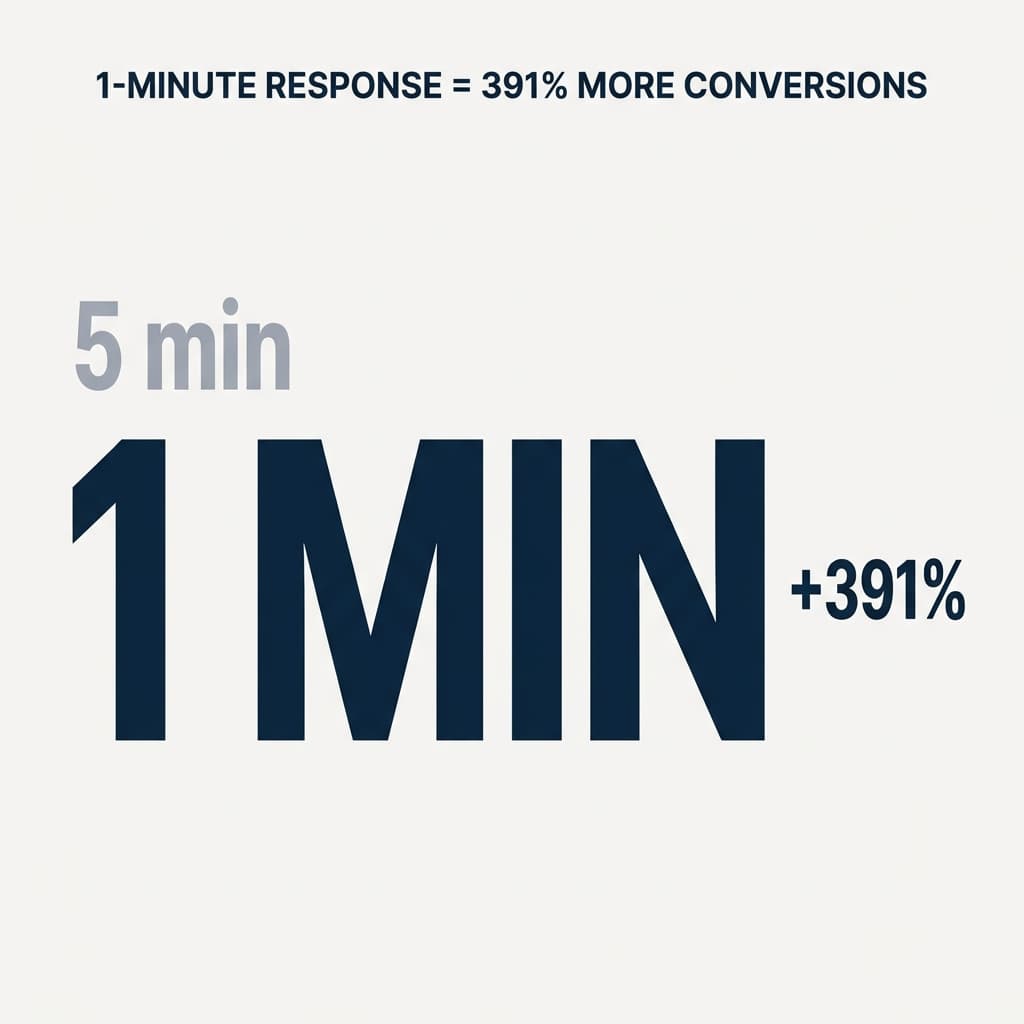
Responding to leads within the first minute increases conversions by 391%. Wait longer than five minutes and lead qualification success drops 10x.
Deliver the report while they’re still in that mindset and they’re curious, a bit concerned, ready to look at the answer.
Wait five minutes or until the next day and that moment has passed. They’ve gone back to work, taken a phone call, dealt with a customer. The urgency faded.
Immediate delivery feels relevant and personal. Delayed delivery feels like another email to ignore.
Bottom line: Timing is the difference between “I should fix this” and “I’ll think about it later.” Later means never.
The Sequence: Cost First, Solution Second
I show them the cost first, then the solution. Order matters.
Lead with the solution and most people skim it. Sounds like general advice. They’re not convinced it applies to them.
Show the cost first, using their own numbers, and suddenly it’s specific. Not a generic problem. Something happening in their business right now.
That’s what makes them stop scrolling and read properly.
Example: Someone tells me they get 8 enquiries a week and convert 2. Sounds fine on the surface.
Break it down and that’s 6 enquiries going nowhere every week. If better follow-up saves a quarter of those, that’s 6 extra jobs a month. At $2,000 per job, you’re looking at $12,000 a month quietly slipping away.
That’s the moment things shift. Not general advice about improving follow-up. Their numbers. Their business. Real money that could be sitting in their bank account.
Once they see the impact, the solution lands differently. Not “here’s something you could do.” It becomes “this is worth fixing now.”
The pattern: Make the problem expensive. Make the solution specific. Make the choice obvious.
How I Tested It: Manually First, Automate Later
I didn’t start by building anything complicated. I tested the idea manually.
I was already having these conversations with clients, so I paid closer attention to what made them stop and think. Never the general advice. Always when we attached real numbers to something they thought was “the way things are.”
So I started structuring those conversations more deliberately. Same questions, same calculations, watching where the reaction happened.
Once I spotted a clear pattern in what landed and what didn’t, I turned it into a simple tool. Nothing fancy. Enough to capture inputs and produce useful output.
Then I tested it in real situations. Prospects, existing contacts, BNI conversations. I wasn’t looking for whether they liked it. I wanted to know if it changed the quality of the conversation afterwards.
When I saw it consistently moved people from “that’s interesting” to “we should fix this,” I knew it was worth building properly.
Lesson here: Test the thinking before you automate the tool. The technology is easy. Getting the logic right takes time.
Where the Real Value Sits (Hint: Not the AI)
Everyone asks about the AI in these tools. The real value isn’t the AI. It’s the thinking behind it.
AI is the delivery mechanism. What matters is the structure of the questions, the logic behind the analysis, and presenting results so they make sense to a business owner.
Most people have access to AI now. That’s not the hard part.
The hard part is knowing what to ask, how to interpret answers, and how to turn that into something practical. That comes from years working with real businesses and seeing the same patterns repeat.
The value sits in the knowledge base, the calculations, and how everything connects. AI allows it to be delivered quickly and consistently, without me being involved every time.
What matters: Your expertise encoded into questions and logic. AI is the wrapper, not the gift.
Why Trades Businesses Are the Perfect Fit
I focus on trades businesses. Builders, plumbers, electricians. They’re a strong fit because the problems are clear once you ask the right questions.
Most of them are busy. Work coming in, phone ringing, looks fine from the outside. Underneath, there are often gaps around follow-up, pricing, quoting, and how their website converts.
What I like about working with trades is they’re practical. Show them something in real numbers and they get it straight away. No long explanation needed.
Show a builder or plumber they’re missing five or six jobs a month through weak follow-up, attach a dollar value, and the conversation changes fast.
With some industries, you get more debate or theory. With trades, it’s more direct. They either see it or they don’t. When they do, they’re quick to act.
Industry data shows consulting and professional services achieve 6-10% conversion rates, far higher than SaaS and tech at 1-3%. Professional services maintain around 4.6% conversion by demonstrating expertise, building trust, and using consultative selling.
Why trades work: They value results over theory. Show them the money they’re losing, they’ll pay to fix it.
Focus on One Problem (Not Five)
I learned quickly that more information isn’t always helpful.
Early on, I showed everything. Every gap, every issue, every possible improvement. I thought I was being thorough. What happened was people felt overwhelmed.
Show someone five or six things at once and they’re not sure where to start. So they delay making a decision, or they do nothing.
Now I keep it tighter. One main issue, explained clearly, with real-world impact attached.
That gives them something they act on. It builds trust too. They see you’re not trying to fix everything at once, simply helping them take the next sensible step.
Once that first issue is addressed, move on to the next one.
Simple rule: One problem. One cost. One solution. Repeat.
How Sales Conversations Changed
Before the tools, most conversations started with discovery.
I’d be asking questions, taking notes, trying to understand how their business worked, where issues might be, what they’d already tried. That part took 15 to 20 minutes, sometimes longer.
Now, when someone’s been through a diagnostic tool, the starting point is completely different.
They’ve already answered the key questions. They’ve seen a breakdown of what’s happening, often with their own numbers. Instead of asking “what do you think the problem is,” we start with “here’s what’s showing up, does that feel right to you?”
That shifts the conversation straight into something more useful.
Research from 6sense shows buyers place four out of five vendors on their shortlist by day one. 95% of the time, the winning vendor is already on that day one list. The vendor ranked first wins about 80% of the time.
For my clients who have these tools on their own websites, the same thing happens. The enquiries they receive are far more informed. Instead of vague messages, they’re hearing from people who already understand their situation.
That means less time qualifying leads, better quality conversations, and a clearer path to the right solution.
Before and after: Before, 20 minutes of discovery. After, 2 minutes confirming what they already know. The time savings compound fast.
The Economics: Better Enquiries Mean Better Margins
Once the tool is in place, it improves both sides of the equation. Close rate goes up. Time spent getting there goes down.
Without a tool like this, lots of time goes into educating people from scratch. Explaining the problem, setting expectations, working out whether they’re even a good fit. That takes multiple conversations, and quite a few go nowhere.
With the tool in place, that work’s already done. The person has seen their situation more clearly, often with numbers attached, and they understand what’s involved.
That lifts the close rate, because you’re not starting with cold or uncertain enquiries. At the same time, time per conversion drops. Fewer back-and-forth conversations, less explaining basics, less time on people who were never going to proceed.
For a trades business, that has real impact. They spend more time on the right jobs, with the right clients, without needing to increase workload to win work.
Companies that embrace personalisation generate 40% more revenue than companies that don’t. 78% of consumers are likely to make repeat purchases from companies that personalise marketing because they feel valued and understood.
What this means for you: Higher close rates and lower time per sale mean you earn more per hour of sales effort. Margins improve without raising prices.
How to Build Your Own System
Step 1: Document your conversations
Start with the conversations you’re already having. What questions do you ask every time? What numbers do you look for? What conclusions do you draw from those numbers?
Step 2: Break it into parts
Questions. Rules. Calculations. Recommendations.
That makes it easier to turn something instinctive into something repeatable.
Step 3: Refine through use
As you use it more, you’ll see where things are too vague, where something needs clearer explanation, or where an extra calculation makes the result more meaningful.
I spent months using these tools on my own websites before offering them to clients. I wanted to see how they behaved in a live environment, not whether they worked technically.
When you use something on your own websites, you see the whole picture. How people find it, whether they complete the form, what answers they give, and how they respond to the report.
Lots of small things only showed up through that. Wording of questions, how long the form felt, whether the numbers made sense to the person reading them, even email timing.
You also see what happens after the report is delivered. Do people reply? Do they book a call? Do they ignore it?
Key steps: Document your process, break it into logic, test it yourself first, refine based on real behaviour.
What to Avoid: Questions That Feel Like Judgement
I avoid questions that make people feel like they’re being judged.
Simple example: asking “Why aren’t you following up properly?” Even if that’s the issue, most people will guess, soften the answer, or skip the question.
Instead, I focus on factual, easy-to-answer questions. How many enquiries they get. How many they convert. How often they follow up.
Those answers give me everything I need. From there, the system highlights the gap without the person feeling criticised. They see it for themselves in the numbers.
That’s a better experience. Keeps people engaged and leads to more honest input, which makes the final result far more useful.
Question design rule: Ask for facts, not feelings. Let the system draw the conclusions.
The Positioning Advantage That Builds Over Time
After a few months, the tool builds consistency. More enquiries come through the tool, more customers have the same experience, overall quality of conversations improves.
Over time, it goes further. They start attracting a different type of enquiry. People who are already thinking more seriously about their situation, more open to doing the job properly rather than looking for the cheapest option.
It also affects how they’re perceived. Instead of being compared purely on price, they’re seen as the one who knows what they’re talking about and took the time to help upfront.
That makes it easier to hold pricing, and in many cases, to improve margins.
After six to twelve months, it becomes part of how the business operates. The tool isn’t another feature on the website. It’s shaping the type of work they win, the clients they deal with, and the conversations they’re having every day.
That’s where the real value builds, because it keeps working in the background, improving the quality of opportunities over time.
Long-term effect: You stop competing on price. You start competing on clarity and trust. Much better position to be in.
What I’d Tell Myself at the Start
Keep it simpler than you think it needs to be.
Early on, I was trying to build something quite detailed and technically clever, thinking that would make it more valuable. In reality, that made it harder for people to engage with.
What works is much simpler. Small number of well-chosen questions, clear language, and one strong insight that feels relevant to the person reading it.
I’d also tell myself to focus more on how people use the tool, not how it works. Things like how long it takes to complete, how it feels to answer the questions, and what they do immediately after receiving the report.
That’s where most of the value sits.
The simpler it is, the more effective it tends to be.
Final thought: Complexity impresses you. Simplicity converts them.
Frequently Asked Questions
How long does it take to build a diagnostic tool?
If you’re testing manually first, a few weeks to refine the questions and logic. Once you’re ready to automate, the technical build takes 1-2 weeks depending on complexity. I spent months refining mine before automating.
Do I need AI to make this work?
No. AI speeds up delivery and makes it scalable, but the value is in your logic and expertise. You start by documenting your process, then automate when you’re confident the thinking is right.
What if my industry is different from trades?
The principle works across industries. You need clear problems, measurable costs, and practical solutions. If you ask the same questions repeatedly in sales calls, you have material for a diagnostic tool.
How do I get people to fill in the diagnostic?
Put it where people are already looking for help. Website, email signature, LinkedIn profile. Offer it as a free resource that gives them clarity on their situation. No obligation, no sales pitch upfront.
What if the report shows they don’t need my help?
Then they don’t need your help. That’s valuable too. You save time, they get honest advice, and they remember you when circumstances change. Better than wasting time on poor-fit prospects.
How do I know what questions to ask?
Listen to the questions you already ask in discovery calls. Look for patterns in what separates good-fit clients from poor-fit ones. Ask for numbers, not opinions. The answers should let you calculate something meaningful.
Should I give away my expertise for free?
You’re giving away clarity, not implementation. The diagnostic shows what’s broken. Fixing it needs expertise, time, and experience. People pay for results, not information.
How often should I update the tool?
Review it every few months based on real usage. If people are dropping off at certain questions, simplify them. If the results aren’t prompting action, make the cost more specific. Let behaviour guide improvements.
Key Takeaways
-
Speed matters more than sophistication. Deliver reports within two minutes while attention is high, or lose 391% of potential conversions.
-
Show cost first, solution second. People skim generic advice but stop scrolling when they see their own money leaking.
-
Test manually before automating. Spend weeks refining the logic and questions with real conversations before building the technology.
-
Focus on one problem at a time. Five issues overwhelm people. One specific problem with a clear cost gets action.
-
The value sits in your expertise, not the AI. Technology delivers your thinking at scale, but your knowledge base and logic are what convert.
-
Trades businesses respond to numbers, not theory. Show them dollars lost through weak follow-up and they’ll move fast to fix it.
-
Ask for facts, not feelings. Factual questions get honest answers. Let the system draw conclusions from the data.